The Democrat’s election interference is over and they WOKE up! How stupid! Just think all of the time and money wasted on all of the fake trials. The Democrats should have to reimburse the American people for all of this waste by Democrats. People should be fired and go to jail.
Jack Smith flew off the handle after a Democrat made this accidental confession
November 27, 202
Jack Smith was the Democrat Party’s insurance policy for the election.
He came up short in his mission to use lawfare to take down Donald Trump.
And Jack Smith flew off the handle after a Democrat made this accidental confession.
Democrat worries Jack Smith’s witch hunt could appear to be politically motivated
Special Counsel Jack Smith’s lawfare witch hunts against President-elect Donald Trump came to an end because of the election.
D.C. District Court Judge Tonya Chutkan granted Smith’s request to dismiss the January 6 case because of the Justice Department’s policy of not prosecuting a sitting President.
He dropped his appeal in the criminal case against Trump over classified documents after it was thrown out when District Court Judge Aileen Cannon ruled he had been unlawfully appointed by Biden Attorney General Merrick Garland.
Democrats had high hopes for Smith’s witch hunt bringing down Trump but it ended up being a dud.
Former Representative Mondaire Jones (D-NY) was worried that voters would think that Smith’s criminal cases were politically motivated when they were dropped after Trump won during an appearance on CNN’s Erin Burnett OutFront.
Jones – a former member of Representative Alexandria Ocasio-Cortez’s (D-NY) “Squad” – fumed that Smith’s witch hunt went down in flames.
“First of all, it cements Merrick Garland’s legacy as being the most ineffective Attorney General of the United States in modern history because he waited so long to open these investigations such that we find ourselves at this point,” Jones said.
The FBI raided Trump’s Mar-a-Lago home in August 2022 in the classified documents cases in an attempt to make that year’s Midterm Elections a referendum on Trump instead of the economy and inflation.
“But also, Donald Trump, unfortunately, is speaking to folks who are not hearing the truth about these investigations, and so this is going to strengthen his argument unfortunately in their minds that these cases were the result of politics rather than the merits,” Jones whined.
Smith’s cases against Trump were politically motivated from the outset and the results on Election Day confirm that voters saw it that way.
Trump’s argument to reform the Justice Department is strengthened
Jones was worried about the possibility that the failure of Smith’s witch hunt would strengthen Trump’s hand in cleaning up the Justice Department.
“I do believe he would have been convicted in both of these matters the way he was convicted earlier this year in a separate matter,” Jones claimed. But this is a real problem. It strengthens his hand when he says he wants to purge the Department of Justice of the Deep State for example, which is something we know is a falsehood. But, to people seeing this voluntary dismissal, many Americans are going to think, ‘Oh so I guess there was no basis for these cases in the first place.’”
Catherine Herridge, a former CBS News investigative reporter, has accused her former employer of deliberately downplaying the Hunter Biden laptop scandal despite explicit directives from the network’s top executives.
In a video posted on X (formerly Twitter), Herridge revealed that she was told “multiple times” by CBS CEO George Cheeks that investigating the story was a high priority—a directive originating from Shari Redstone, the controlling shareholder of CBS’s parent company, Paramount Global.
“George Cheeks told me on multiple occasions that this was a story of the highest priority for the network and for his boss, Shari Redstone,” Herridge said. She added, “I took on that assignment and did it to the best of my ability.”
Despite this clear mandate, Herridge claims her efforts faced internal resistance from senior executives at CBS News, who were reluctant to pursue the story.
While Cheeks emphasized the need to “speak truth to power on both sides of the aisle,” Herridge encountered pushback from CBS News President Ingrid Ciprian-Matthews and Washington Bureau Chief Mark Lima. She alleges that these senior figures undermined her reporting and even killed stories that revealed potentially damaging information about Hunter Biden and President Joe Biden.
Herridge highlighted one instance in October 2020, before the presidential election, when she presented evidence that Hunter Biden’s laptop contained details about a “million-dollar retainer from a Chinese energy firm” and business-related texts and emails. This evidence, she says, was never aired.
“When we did the story, we did it after the midterms,” Herridge noted in her video. “I argued against that because it was ready before the midterms, and my training is that you should always do the story when it’s ready. You should not be dictated by the political cycle.”
Herridge also recounted other instances of her reporting being sidelined. She had uncovered text messages from Hunter Biden containing offensive language, ending liberal use of a racial slur, as well as emails allegedly tied to Joe Biden. According to Herridge, CBS executives dismissed these findings as unworthy of coverage.
The investigative reporter said she was baffled by the disconnect between Cheeks’ directives and the actions of CBS News executives.
“I didn’t understand how a senior executive like George Cheeks could tell me that this was a high priority for the network and for his boss, and yet the executives at CBS News could defy that,” Herridge said. “I came to the conclusion that they must have felt they were more powerful than George Cheeks, which was astonishing to me.”
Herridge believes this internal conflict reflects deeper issues within CBS News, where political sensitivities often appear to outweigh journalistic princiThe New York Post was the only major outlet to report on the Hunter Biden laptop story when it broke in 2020, but their reporting was met with bans from social media platforms like Twitter and Facebook. It wasn’t until two years later that CBS aired a forensic review of the laptop’s contents. By that time, Ciprian-Matthews had been promoted to CBS News president.
Herridge said this delay was emblematic of CBS’s unwillingness to address politically sensitive stories in real-time. “The answer that came back was, ‘We need to know what the content is of the emails,’” Herridge said, referring to emails tied to Joe Biden. She was told it could take years to verify the information and was subsequently instructed to drop the story.
Earlier this year, Herridge was laid off during a round of company-wide layoffs at CBS’s parent company, Paramount Global. She found the timing suspicious, noting that her termination came just a day after she reported on Special Counsel Robert Hur’s investigation into classified documents found in Joe Biden’s possession.
Herridge described the report as “highly critical of the president,” adding that it characterized him as “a nice old man with a bad memory” and concluded he could not be prosecuted.
“I found the timing significant,” Herridge said, suggesting her termination was linked to her investigative work on stories that were “not popular” within CBS News.
CBS seized Herridge’s reporting materials upon her departure, but they were returned days later following pressure from her union.
Herridge’s allegations raise broader concerns about editorial independence and the influence of political bias within mainstream media. As CBS News declined to comment, the controversy leaves unanswered questions about whether corporate leadership at the Tiffany Network has allowed internal resistance to dictate its editorial priorities.
For Herridge, the experience has underscored the importance of pursuing the truth, no matter the opposition. “I did everything I could to put CBS first on a story that was not popular among a lot of people in that network,” she said.
The fallout from her termination and revelations about CBS’s handling of the Hunter Biden story may prompt renewed scrutiny of how major media outlets navigate politically charged topics.
The Democrats blew a wad of money – trillions – and now don’t want to take credit for the spending. The same thing happened with Kamala Harris’ campaign. They blew the roof off in their spending because Democrats aren’t business-minded and don’t know how to spend money. For starters – they don’t know how the world works – so here we are with nothing to show for their spending – but a debit they can’t explain.
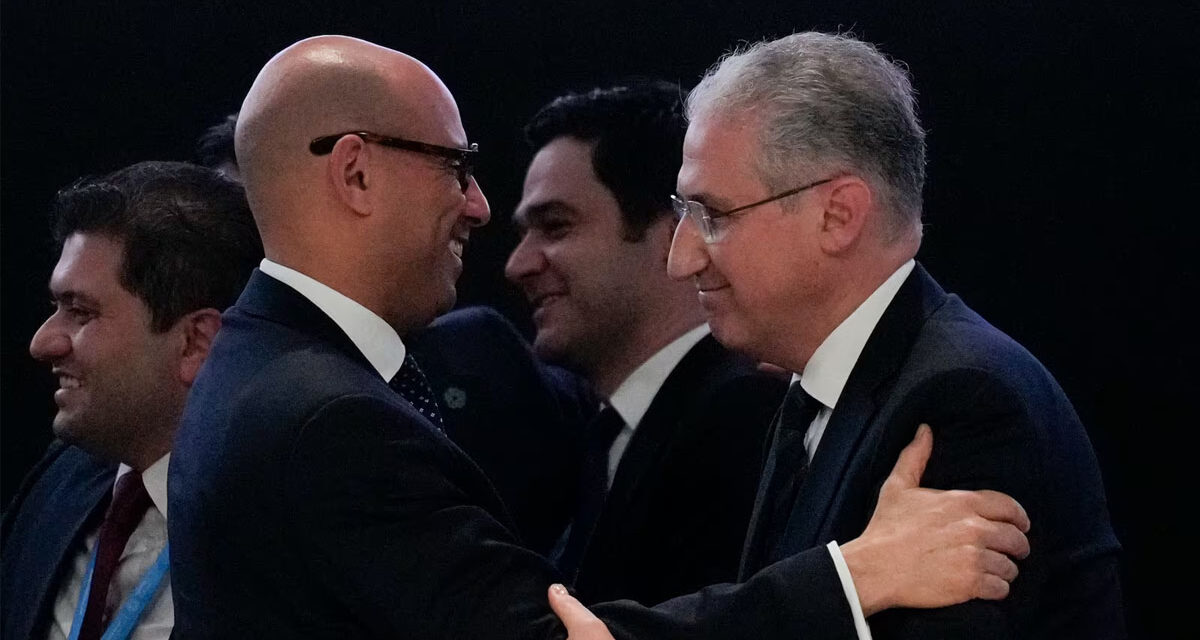
The United Nations climate summit in Baku, Azerbaijan, concluded with an agreement that seeks to inject $300 billion annually into the global fight against climate change. This funding is intended to assist developing nations in transitioning to clean energy, adapting to climate impacts, and addressing the mounting damage caused by extreme weather events. While the deal has been hailed as a step forward, it has also drawn criticism for falling short of the financial support many nations deem necessary.
The agreement has sparked a mix of hope and frustration, underscoring the complexities of international climate negotiations.
A Framework for Funding
The $300 billion climate financing deal, set to triple previous commitments, builds on earlier agreements made at the 2009 Copenhagen summit. Under the new deal, developed countries—including the United States, European Union members, and other historically high emitters—pledged to significantly increase their financial contributions by 2035.
The $300 billion annual target is expected to be sourced from a combination of public and private financing. Developed nations are tasked with leading the contributions through their government budgets, but the agreement also emphasizes the role of private sector investments and multilateral development banks in reaching the goal. Additionally, the deal introduces the idea of “alternative sources,” which include potential global taxes on industries such as aviation and maritime shipping. The hope is that these diverse funding streams will not only meet the immediate $300 billion target but also pave the way for the larger $1.3 trillion goal envisioned for the next decade. However, concerns remain about whether these sources will be sufficient and whether funds provided as loans could further burden already indebted nations.
European Union Climate Commissioner Wopke Hoekstra expressed optimism, stating, “With these funds and with this structure, we are confident we will reach the $1.3 trillion objective.” However, this larger goal is not yet guaranteed, relying heavily on private sector contributions and multilateral development banks to supplement government financing.
While the $300 billion commitment marks a significant increase from the $100 billion pledged in 2009, it remains well below the $1.3 trillion annually that experts and developing nations argue is necessary by the next decade.
A Polarized Response
Despite the agreement, tensions ran high at COP29, with many developing nations expressing frustration over what they perceived as inadequate funding and unfair negotiation processes. India’s delegate, Chandni Raina, criticized the agreement in stark terms, calling it a “paltry sum” that does not meet the urgent needs of vulnerable nations. “It’s too little, it’s too distant. It is 2035, too far gone,” she remarked, highlighting the disappointment felt by many developing countries.
Others echoed these sentiments. Nigeria’s Nkiruka Maduekwe described the deal as “an insult and a joke,” while Juan Carlos Monterrey of Panama noted that although minor improvements were made in the final hours—such as adding the phrase “at least” before the $300 billion target—the agreement ultimately failed to inspire confidence. “Our heart goes out to all those nations that feel like they were walked over,” Monterrey said.
Criticism was not limited to the funding amount. Many delegates were angered by the way the agreement was pushed through. Mukhtar Babayev, the COP29 President, gaveled the deal into acceptance before some nations had the opportunity to speak. This procedural move sparked outrage, with Raina accusing the process of being “unfair” and “extremely hurtful.”
The Bigger Picture
Despite the ambitious-sounding numbers, the $300 billion deal is only a fraction of the funds required to address the goals fo the U.N. Experts estimate that the total cost of adapting to climate change and transitioning to green energy in developing nations will reach trillions of dollars annually by 2030. As it stands, the $300 billion commitment barely scratches the surface of these monumental financial demands.
Adding to the complexity, developed nations have historically struggled to meet even smaller funding commitments. A $100 billion annual climate financing goal set in 2009 was only achieved in 2022, two years behind schedule. This history raises doubts about the feasibility of the new, much larger target.
Political uncertainty in donor countries further complicates the situation. In the United States, the incoming Trump administration has signaled plans to cut climate financing and withdraw from the Paris Agreement. Elon Musk, tasked with overseeing federal spending cuts under Trump, has already called climate-related jobs in federal agencies “fake jobs.” Such rhetoric casts a shadow over the U.S.’s ability to fulfill its commitments, potentially leaving Europe and other developed nations to fill the funding gap.
Divisions Over Responsibility
One of the most contentious aspects of the negotiations was the question of who should bear the financial burden of climate change. Wealthy nations have pushed for higher-income developing countries—such as China and Saudi Arabia—to contribute to climate financing. While these countries are classified as “developing” under U.N. treaties, their economic growth and rising greenhouse gas emissions have led to calls for a reevaluation of their responsibilities.
China, now the world’s largest emitter of carbon dioxide, has resisted such changes, emphasizing that it already provides bilateral aid to poorer nations. China has already committed to building over 100 new coal fired generating plants. Since 2016, China has contributed $25 billion to green energy projects in other developing countries. The final agreement reflects a compromise, encouraging—but not requiring—wealthier developing nations to make voluntary contributions.
This issue has further divided the developing bloc, with smaller nations like those in the Alliance of Small Island States demanding more immediate and substantial support. Evans Davie Njewa of Malawi noted that while his country supported the agreement, it did so with reservations, reflecting the broader dissatisfaction among the most vulnerable nations.
Missing Commitments on Fossil Fuels
Another major disappointment for climate advocates was the absence of explicit language calling for a transition away from fossil fuels. At last year’s COP28 in Dubai, nations had agreed to such a transition, but this commitment was notably missing from the Baku agreement. Instead, the final text included only a vague reference to the Dubai deal, which many see as a concession to oil-producing countries like Saudi Arabia.
Tamara Gilbertson of the Indigenous Environmental Network criticized the deal for undermining efforts to limit warming to 1.5 degrees Celsius, calling it a “climate scam” riddled with loopholes. This omission has left activists and negotiators questioning the seriousness of global commitments to reduce emissions.
While the $300 billion climate financing deal represents progress, it also highlights the vast challenges that remain. U.N. Secretary-General António Guterres acknowledged the shortcomings of the agreement, stating that it “provides a base on which to build” but expressing hope for a “more ambitious outcome” in the future.
Attention now turns to COP30 in Brazil, where negotiators will have another opportunity to address unresolved issues, including the scale of funding and the transition away from fossil fuels. For now, the Baku agreement is a reminder of both the strides made and the obstacles that lie ahead in the fight against climate change.
The question remains: Will the world’s wealthiest nations step up to meet the urgency of the climate crisis, or will vulnerable nations continue to bear the brunt of inaction?
Editor’s Notes: Clearly the U.N. is attempting to shame the U.S. into funding a great deal of this, but they are not prepared to deal with Trump. The timing is such that Biden’s Ambassador to the U.N., Linda Thomas-Greenfield, would not fight this. We have noted before that subsidies are keeping renewable energy artificially high, so this funding may end up doing more harm than good.