Fox News’ Peter Doocy reports the latest on fallout from Zelenskyy’s heated Oval Office meeting with President Donald Trump. Former U.S. ambassador to the EU Gordon Sondland joined ‘The Faulkner Focus’ to weigh as he faces calls to resign.
President Donald Trump once again attacked Ukrainian President Volodymyr Zelenskyy on Monday after the Ukrainian leader suggested the end of its war with Russia remains “very, very far away.”
Trump made the statement on social media, reacting to news reports of Zelenskyy’s comments. The White House has said it wants a public apology from Zelenskyy for a contentious meeting with Trump and Vice President JD Vance on Friday.
“This is the worst statement that could have been made by Zelenskyy, and America will not put up with it for much longer! It is what I was saying. This guy doesn’t want there to be Peace as long as he has America’s backing,” Trump wrote.
“Europe, in the meeting they had with Zelenskyy, stated flatly that they cannot do the job without the U.S. – Probably not a great statement to have been made in terms of a show of strength against Russia. What are they thinking?” he added.
Trump’s statement comes after Zelenskyy met with U.K. Prime Minister Keir Starmer and French President Emmanuel Macron, among other European leaders.
Ukraine’s leader had been scheduled to visit the White House last week to sign a rare earth minerals agreement with the Trump administration, but he was kicked out before signing the deal. While Zelenskyy says he is still willing to sign the deal, Trump’s White House says they now expect a public apology.
President Donald Trump, right, meets with Ukrainian President Volodymyr Zelenskyy in the Oval Office at the White House, Friday, Feb. 28, 2025, in Washington, D.C. (AP Photo/ Mystyslav Chernov)
Zelenskyy retorted that Graham could weigh in on Ukrainian leadership when he became a Ukrainian citizen, to which Graham responded: “Unfortunately, until there is an election, no one has a voice in Ukraine.”
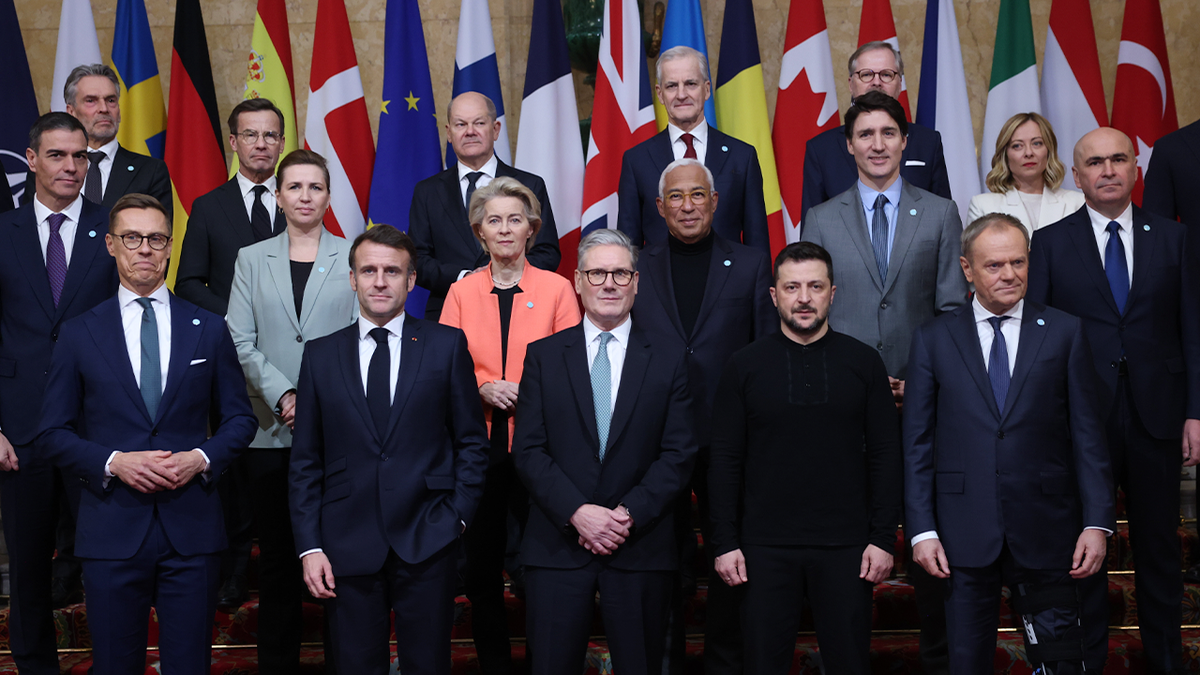
Keir Starmer, U.K.’s prime minister, at bottom center, Volodymyr Zelenskiy, Ukraine’s president, bottom second right, and other world leaders are seen at the Lancaster House in London, U.K., on Sunday, March 2, 2025. (Getty Images)
According to the senator, he doesn’t think Americans see the Ukrainian president as someone they feel comfortable going “into business with” following the televised dispute.
Graham also stressed that the Ukrainian-American relationship is “vitally important.” However, he cast doubt on whether Zelenskyy could ever “do a deal with the United States.”
Fox News’ Peter Doocy contributed to this report.
Anders Hagstrom is a reporter with Fox News Digital covering national politics and major breaking news events. Send tips to Anders.Hagstrom@Fox.com, or on Twitter: @Hagstrom_Anders.
****
Zelenskyy must remember – CLOSE is only good in horse shoes! Just sayin’!
President Trump’s nominees to lead the Federal Housing Finance Agency (FHFA) and the Consumer Financial Protection Bureau (CFPB) pledged to bring reform to their respective agencies.
In testimony delivered today before the Senate Banking, Housing and Urban Affairs Committee, the designated FHFA director Bill Pulte noted his connection to the housing market began in his youth when he worked on his family’s homebuilding sites.
“I have seen firsthand the devastating consequences of bad policy on housing and the economy,” said Pulte. “In 2008, the housing crash nearly destroyed our family’s legacy company. In 2020, as a director of Pulte Homes, I witnessed how the Covid-19 pandemic placed our housing finance system under unprecedented strain.”
Pulte, the CEO of the investment firm Pulte Capital Partners, stated his “number one mission will be to strengthen and safeguard the housing finance system.” He also touched upon the hot-button topic of ending the federal conservatorship of the government-sponsored enterprises that has been in place since September 2008.
“Under President Trump’s leadership in his first term, Americans were able to realize the American Dream of homeownership through Fannie Mae and Freddie Mac, and to that end, while their conservatorships should not be indefinite, any exit from conservatorship must be carefully planned to ensure the safety and soundness of the housing market without upward pressures on mortgage rates,” Pulte stated, adding “I will be laser focused on ensuring that Fannie Mae and Freddie Mac operate in a safe and sound manner.”
In his testimony, the designated CFPB director Jonathan McKernan cited his work as a director with the Federal Deposit Insurance Corporation and his “staff roles in the Senate, the Department of the Treasury, the FHFA, and even a short detail to the CFPB, all focused on the mortgage market, one of the key markets supervised by the CFPB.” Also noted his “nine years as a lawyer focused on banking and consumer financial laws” in a legal career that launched at the start of the 2008 financial crisis.
While noting the need for consumer protection, McKernan stressed the CFPB had issues that needed to be addressed.
“All too often, however, the CFPB has gotten in the way of its own mission,” he said. “It has acted in a politicized manner. It has pushed beyond the limits of its statutory authority. It has seized opportunities to expand its jurisdiction and power. It has offended our basic notions of fairness and due process when it has regulated by enforcement. And it has harmed consumers through higher prices and reduced choice when it has failed to strike an appropriate balance between costs and benefits in prescribing new regulations.”
McKernan added, “Even if you don’t agree with that view, it’s clear that the CFPB suffers from a crisis of legitimacy. This must be corrected if the CFPB is to reliably do what it’s supposed to do – look out for the American consumer. To that noble end, the CFPB needs to be made accountable to our elected officials and its past excesses need to come to an end.”
McKernan did not cite the need to shutter the CFPB, but instead promised to have the agency “take all steps necessary to implement and enforce the federal consumer financial laws and perform each of its other statutorily assigned functions. But the CFPB will do this by centering its regulation on real risks to consumers and by focusing its enforcement on bad actors.”
****
Musk needs to have a system in place which checks out all of these agencies and they have to meet his checks and balances after start-up and don’t go back into the old system of operating.
An example would be to have a coded computerized check-up automatically engrained into each agency by Musk’s DOGE group when they spend the taxpayer’s money, i.e., don’t allow the final check to be printed until all the “t’s are crossed and the i’s have their dots.
An open-source researcher documented stunning Russian losses in one yearlong assault in Ukraine.
The losses occurred during Russian offensives to seize Avdiivka and now Pokrovsk.
Russian forces have yet to make decisive tactical gains in the region.
An open-source researcher who tracks visually confirmed military losses in Ukraine published new findings indicating that Russia has lost more than 1,800 armored vehicles, tanks, and other pieces of heavy equipment in a single yearlong assault, a staggering figure that raises questions about Russia’s ability to continue its advance.
In February, Russia seized the town of Avdiivka, a longtime Ukrainian stronghold, after a monthslong campaign that contributed to “some of the highest Russian casualty rates of the war so far,” according to British military intelligence.
Moscow’s losses — both in equipment and personnel — only continued to grow as it advanced in the western Donetsk region, an onslaught against Ukraine’s defended positions that contributed to the heavy toll in September; a US official recently said that month saw the highest Russian casualties in the entire war.
In early October, two key Ukrainian front-line towns, Vuhledar and Hrodivka, fell to Russia during its advance toward Pokrovsk, a strategic city serving as a road and rail hub to supply Ukrainian military outposts.
Despite the heavy equipment losses, Russian forces have yet to make concrete tactical gains in the region, advancing only about 25 miles toward the key Ukrainian city.
A new report by the Institute for the Study of War said the reported losses amounted to at least five divisions’ worth of combat vehicles, citing an open-source X account tracking visually confirmed Russian vehicle and equipment losses.
Russian forces have also lost rockets, antiaircraft systems, and drones in its offensive along the eastern front. This is a breakdown of the heavy losses that could jeopardize Russia’s ability to expand its battlefield gains.See more
European leaders held emergency talks to discuss support for Ukraine on Sunday.
It came amid souring relations between the US and Ukraine, raising pressure on Europe to step up.
One quick way to raise “game-changing” cash would be to seize $218 billion in frozen Russian assets.
Amid growing tensions between Washington and Kyiv, calls are growing for Europe to take an unprecedented step that could unlock billions in funding for Ukraine.
Some world leaders and politicians, including former UK Prime Minister Rishi Sunak, are urging European countries to seize the roughly $218 billion in frozen Russian central bank assets — now largely held in Brussels — and hand them to Ukraine.
“It is only fair that Russia should pay for the damage its war has caused,” Sunak wrote in an opinion piece for The Economist on Friday.
The question of funding was a hot topic on Sunday as EU and UK leaders met with Ukrainian President Volodymyr Zelenskyy for emergency talks in London to discuss support for Kyiv — just days after the latter’s unprecedented Oval Office clash with President Donald Trump and Vice President JD Vance.
Trump and Vance berated the Ukrainian leader on Friday in front of reporters and cameras. Zelenskyy ultimately left the White House without finalizing a minerals deal that would give the United States access to Kyiv’s mineral wealth in exchange for investment and what Zelenskyy hoped would be security guarantees.
The situation has fueled questions over how Europe can step up to help aid Ukraine’s defense efforts should the United States reduce, or cut altogether, its support for the war-torn nation.
For Europe to make up the difference would be an expensive prospect and one that could come with political repercussions — which makes the potential to unlock $218 billion in non-taxpayer money all the more attractive.
“We’ve got all of these different countries with their own internal political battles, and their own internal budgets, all trying to find more cash — and we’re sitting on a game-changing amount of funding,” Heather Buchanan, the chair of the Athena Foundation, an economic policy advisory nonprofit that supports the move, told Business Insider.
Europe’s ace card?
The EU holds the majority of the roughly $300 billion in Russian funds frozen by the United States and international allies after Moscow launched its full-scale invasion in February 2022. The funds have been earmarked for rebuilding Ukraine in peacetime.
Some of the interest earned on those funds has been transferred to Ukraine as loans. The UK’s chancellor of the exchequer, Rachel Reeves, and Ukraine’s finance minister, Sergii Marchenko, signed a deal on Saturday to deliver another £2.26 billion, or about $2.8 billion, to Ukraine from the accrued interest, also as a loan.
But there’s now growing support for a long-considered option: seizing those frozen funds, which would allow them to be transferred directly to Ukraine for use in its defense.
In December, Kaja Kallas, the EU’s top diplomat, called for the move — and it’s seen support in the past week from leaders in the UK, Estonia, Poland, and Finland.
On Saturday, a coalition of campaign groups and UK MPs brought together by the Athena Foundation called on the UK to get the ball rolling with the seizure of £25 billion, or about $31.4 billion, of Russian state assets now frozen in the UK financial system.
Adrian Karatnycky, a nonresident senior fellow with the Atlantic Council’s Eurasia Center, wrote in Foreign Policy magazine in January that the full $300 billion in frozen assets could replace the US contribution to Ukraine for the next six or seven years if Trump were to cut support to Kyiv.
A nervous gambit
“The key blocker is that nobody wants to move alone,” Buchanan said.
But the White House’s recent moves have provided a “perfect storm” that is focusing minds, she added.
While many politicians are pushing for the move, some analysts warn that it should be a last resort because of the impact it could have on global economies.
For example, permanently confiscating Russian assets held in countries that aren’t at war with Russia could also “increase the risk perceived by several other countries,” Creon Butler, the director of Chatham House’s global economy and finance program, wrote last year.
Other countries — such as China, India, and Saudi Arabia — may “fear that at some point they could be subject to similar measures,” he wrote.
Sunak, writing for The Economist, has argued that those concerns are “overstated” and that this risk “can be contained.”
There’s also a debate among analysts over whether the assets should be kept available as a bargaining chip for any future peace talks.
Legal complications must also be considered, as the assets of a foreign nation are normally protected against seizure by a host country.
But the leading lawyer Paul Reichler previously argued to Congress that such protection falls apart when a host state carries out “egregiously wrongful conduct,” as he said Russia had.
“If Congress has the power to authorize the executive to freeze a foreign state’s assets, it must also have the power to authorize the executive to transfer them,” he said.
Buchanan told BI that such a move does require legislation but that “that’s what lawmakers are for,” adding that meeting a satisfactory legal standard could be brought about “quite quickly.”
A further worry is the prospect of retaliation by the Kremlin, whose State Duma is discussing a draft bill allowing it to confiscate foreign property in response to similar moves from “unfriendly countries,” Reuters reported.
Striking a psychological blow
Buchanan said passing the cash to Ukraine would send a “crystal clear” signal to Russia that this money isn’t coming back — potentially dealing a strong psychological blow to a country whose economy and labor market are already deeply strained by the war.
The question is whether Western leaders will take the leap.
“It’s just political will at this point,” she added.
Business Insider
How Anonymous actually works, according to a former hacktivistUnmute
In the annals of government reform efforts, the efforts of Elon Musk and his task force of DOGE techies are more than tough love.
Because the so-called Department of Government Efficiency has (mostly) been given access to the books of government agencies, it has spotted billions of dollars in questionable grants, make-work programs, and outright gifts to politically connected activists who provided political support to their government paymasters. On the most recent episode of The Drill Down, hosts Peter Schweizer and Eric Eggers discuss a few examples, but also address a deeper question: “So what?”
“Even if the cuts DOGE has found are drops of water in the ocean of the U.S. national debt,” says Schweizer, “they shift the conversation.”
From a $324,000 grant to enhance “Diversity, Equity, and Inclusion (DEI) programming within Integrated Pest Management” at the agriculture department to a $3 million Department of Education report that showed that its previous reports were not being used, the details are eye-popping even where the amounts are not. The General Services Administration purchased 37,000 WinZip licenses for employees, DOGE found, although its file shrinking functions have been part of the Windows operating system for years, for example.
Schweizer stresses that the stories show not just bureaucratic inertia, but efforts by the political class to launder money. At the Environmental Protection Agency, new director Lee Zeldin unearthed a $2 billion grant to a start-up nonprofit group associated with Georgia Democratic candidate Stacey Abrams.
The $2 billion was used for the “decarbonization of homes” in low-income communities and paid for new household appliances, such as water heaters, induction stoves, solar panels, EV chargers, and weatherization, according to an April 2024 press release from Power Forward Communities as reported by Fox News.
Zeldin also identified a potential “conflict of interest” payment of $5 billion to the former director of the Greenhouse Gas Reduction Fund under President Joe Biden. “All this money was put up front,” Zeldin said. “It was going to their friends on the left.”
The CEO of Stacey Abrams’s “Power Forward” nonprofit was a man named Timothy Mayopoulos, a lawyer and businessman and also a former political appointee under the Obama administration to Fannie Mae.
The problem with this kind of grant-making, Schweizer points out, is that little of the money actually gets to the people it is supposed to help. “By the time it gets to the double-wide trailer for better insulation, a huge percentage of it has gone to these politically connected cronies,” he says.
This kind of “nest-feathering” is nothing new. In his book Throw Them All Out, Schweizer pointed out that under the Obama administration 80 percent of the grants and loans given to green-energy startup companies were given to companies associated to members of the Obama campaign’s finance committee.
“This is why DOGE is important,” Schweizer says. “It is exposing the money-laundering operations.”
In his book Clinton Cash, Schweizer reported how the Clintons steered USAID funds to help their foundation’s benefactors. Among them was an Irish entrepreneur named Denis O’Brien. His company, Digicel, got a $2.5 million contract in earthquake-ravaged Haiti to create digital banking services.
“It was called the Haiti Mobile Money Initiative. This was a dual grant award from USAID and the [Bill and Melinda] Gates Foundation. So, they funded a cell phone banking system,” he explains. “Now, it just so happens that there’s a guy who runs a cell phone company in Haiti, who is a very good “Friend of Bill.” He adds that Bill Clinton made a series of speeches in Ireland that were sponsored by O’Brien, and the Clinton Foundation received a donation.
Schweizer reported in Clinton Cash that in September 2010, weeks after Digicel applied to receive the grant, Bill Clinton gave three speeches in Ireland and Jamaica that were sponsored by O’Brien. The Clinton Foundation received a donation after the speeches, and the foundation’s records show that O’Brien personally donated between $5 million and $10 million sometime between 2010 and 2011.
And, naturally, the Biden family repeated the pattern. Funds from a USAID program during the Obama administration to enhance oil and gas production in Ukraine went to the Ukrainian company Burisma for a “municipal energy reform project.” The funding arrived a few months after Burisma put Vice President Joe Biden’s son Hunter on its board of directors, despite his having no experience in the oil and gas business.
“This is legal graft,” Schweizer says. “You figure out a way to do it. So, you are crossing the T’s and dotting the I’s, but you are basically manipulating and funneling that money to other entities.”https://playlist.megaphone.fm/?e=SHDI5110788113
For more from Peter Schweizer, subscribe to The DrillDown podcast.




 Business Insider

