
08/31/2026
As usual when trying to help the people, WordPress interferes and I will have to paste a stamp of interference on these “snotty nose boggers.”
How many times do we have to go through this? When the people’s money is stolen? Isn’t it time for the great minds to sit down and find a solution. Trust but verify.
If any deletion, just add an “h” to the above to view.
Key Points
- Valuations are soaring, which brings good and bad news for investors.
- Overvalued stocks could pose the greatest risk during a market pullback.
- Warren Buffett warns that some investors may be taking unnecessary risks right now.
- 10 stocks we like better than S&P 500 Index ›
The stock market has been on a record-breaking run over the past few years, with the S&P 500 (SNPINDEX: ^GSPC), Nasdaq Composite (NASDAQINDEX: ^IXIC), and Dow Jones Industrial Average (DJINDICES: ^DJI) all reaching new heights.
But despite the impressive gains, stock prices can’t continue surging forever. While nobody can predict the market’s short-term movements, it’s only a matter of time before we face another bear market. And according to Warren Buffett, some investors may be in for a rude awakening.
Missed Nvidia in 2009? This Rare Signal Is Flashing Again. In 2009, a “Double Down” signal flashed for a little-known chipmaker called Nvidia. For the first time in years, that same “Total Conviction” signal is flashing for a company 1/100th the size of Nvidia. Continue »

Closeup of Warren Buffett at an event.© The Motley Fool
Warren Buffett warns that some investors are “gambling”
In an interview with CNBC during Berkshire Hathaway‘s annual meeting earlier this year, Buffett offered his thoughts on this historically expensive market.
He noted that he often compares the market to a church with a casino attached — representing slow-and-steady long-term investing and short-term risk-taking. “[T]he casino has gotten very attractive to people,” Buffett warned, going on to emphasize that “that’s not investing, it’s not speculating, it’s gambling.
Sometimes, the riskiest investments are the ones investors don’t even realize are risky. When the market is booming, it’s increasingly likely that some stocks are overvalued. These stocks can surge in the short term, but they generally correct themselves over time.
Even more dangerous are the hype-fueled investments that have little substance to back up their soaring stock prices. We’ve already seen this play out with the dot-com bubble, when many tech companies broke IPO records only to go bankrupt a few years later when the market collapsed beneath them.
The stock market has a warning of its own
With company valuations soaring, the broader market itself is also becoming more expensive. The S&P 500 Shiller CAPE ratio is a valuation metric that tracks the index’s inflation-adjusted earnings over the last decade.
A higher ratio suggests that the market is trading at a premium, and historically, stock prices tend to fall in the years following a peak. Since 1871, the S&P 500 Shiller CAPE Ratio has averaged around 17. It hit an all-time high of 44 in 1999, just before the dot-com bubble popped, and it’s now surpassed 40 again for only the second time in history.
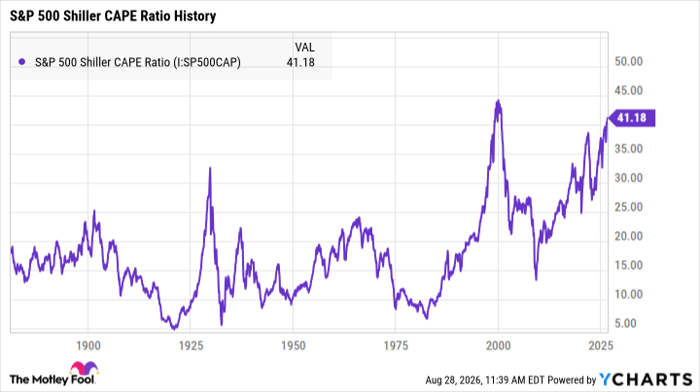
So, does this mean we’re in a stock market bubble? Not necessarily.
The market landscape has transformed significantly over the past two decades, and higher valuations don’t automatically indicate a stock is overvalued. If the artificial intelligence (AI) boom — which has fueled much of the market’s returns over the last few years — contributes to meaningful economic growth, these higher valuations may be justified.
The risk to investors, though, is that there are plenty of overvalued stocks hidden among the fairly valued companies. Invest in the wrong stocks, and your portfolio could face a steep decline during the next bear market.
Fund.com·Sponsored
No matter what may be coming for the market, the best move you can make right now is to ensure you’re only investing in healthy stocks with robust underlying business fundamentals. Strong companies may still experience short-term volatility, but they’re far more likely to thrive over the long haul.
Should you buy stock in S&P 500 Index right now?
Before you buy stock in S&P 500 Index, consider this:
The Motley Fool Stock Advisor analyst team just identified what they believe are the 10 best stocks for investors to buy now… and S&P 500 Index wasn’t one of them. The 10 stocks that made the cut could produce monster returns in the coming years.
Consider when Netflix made this list on December 17, 2004… if you invested $1,000 at the time of our recommendation, you’d have $440,710!* Or when Nvidia made this list on April 15, 2005… if you invested $1,000 at the time of our recommendation, you’d have $1,335,252!*
Now, it’s worth noting Stock Advisor’s total average return is 978% — a market-crushing outperformance compared to 213% for the S&P 500. Don’t miss the latest top 10 list, available with Stock Advisor, and join an investing community built by individual investors for individual investors.
*Stock Advisor returns as of August 31, 2026.
Katie Brockman has no position in any of the stocks mentioned. The Motley Fool has positions in and recommends Berkshire Hathaway. The Motley Fool has a disclosure policy.
****
Thanks to both of you for helping the people.

Cuban, Burry warn of Nvidia-fueled AI bubble© Photo by Kent NISHIMURA / AFP via Getty Images; Photo by Jim Spellman/WireImage
This article adheres to strict editorial standards. Some or all links may be monetized.
One of the most powerful forces driving the U.S. stock market may be resting on a surprisingly fragile foundation.
Billionaire entrepreneur Mark Cuban and “Big Short” investor Michael Burry are now raising the same unsettling concern: One unexpected disruption could bring the entire boom crashing down.
Must Read
- Jeff Bezos backs a platform that lets anyone invest in rental homes for as little as $100 — 6 ways to build wealth like a landlord without actually being one
- JPMorgan sees gold hitting $5,000/oz by Q4 — and savvy investors are protecting their wealth with a tax-advantaged Gold IRA. Get your free guide from Goldco
- Dave Ramsey warns nearly 50% of Americans are making 1 big Social Security mistake. Here’s what it is and 3 simple steps to fix it ASAP
Cuban pointed directly to Nvidia (NASDAQ:NVDA) and its central role in financing the artificial intelligence boom.
“You never know where an exogenous change is going to come from. This is so analogous to the dot-com burst. But instead of IPOs, Nvidia is the ‘ipo,’ funding everyone and anyone,” Cuban wrote in a post on X (1).
“One breakthrough in another chip provider, or a misstep and it all could crumble. It’s truly scary.”
Burry echoed those concerns, pointing to a sharp rise in the cost of insuring Nvidia’s debt against default.
“There is a reason $NVDA’s 5-year credit default swaps are going parabolic,” he wrote (2). “All this overreaching by #nvda to push the circular spending to biblical proportions.”
Their warnings arrive at a delicate time for investors.
Nvidia has grown into one of the largest and most influential companies in the world, while AI-related stocks have become increasingly important to the performance of major market indexes.
That means the potential fallout could extend far beyond investors who deliberately bought Nvidia shares.
Americans held $9.9 trillion in 401(k) plans at the end of the first quarter, including $3.3 trillion invested in equity mutual funds, according to the Investment Company Institute (3). IRAs contained another $4.2 trillion in equity funds.
Many of those retirement accounts hold funds that track or resemble the S&P 500, where Nvidia represents roughly 7.3% of the index. Meanwhile, information technology stocks now make up 38% (4) of the S&P 500, while major AI spenders like Amazon (NASDAQ:AMZN), Alphabet (NASDAQ:GOOGL) and Meta (NASDAQ:META) also ranked among its largest holdings. That means billions — and potentially hundreds of billions — of dollars in Americans’ retirement savings may be indirectly exposed to the chipmaker and the wider AI boom.
‘The biggest investment bubble in American history’
Cuban and Burry are not the only prominent investors sounding the alarm.
Legendary investor Jeremy Grantham, who famously warned about the 2000 dot-com bust and the 2008 financial crisis, recently described the current market as “the biggest investment bubble in American history.”
Grantham said high-flying AI stocks “will probably come down a lot.” But his warning extends far beyond the tech sector. He believes the entire U.S. stock market is headed for a brutal reck“The market’s going to peak out and drop back to trend. And getting back to trend from here is closer to a 70% decline than a 50%,” he warned.
That is a dire forecast — and one that could carry serious consequences for millions of Americans whose retirement savings are heavily exposed to equities.
Whether or not you buy into these warnings, the message is difficult to ignore: When valuations are stretched and a group of dominant stocks increasingly depends on the fortunes of one industry — or even one company — putting all your eggs in one basket can be dangerous.
Here are three simple ways to diversify beyond traditional stocks.
Own what Wall Street can’t print
When storm clouds gather over the markets, gold often steps back into the spotlight — and for good reason.
Long seen as the ultimate safe haven, gold isn’t tied to any single country, currency or economy. It can’t be created at will by central banks like fiat money and in times of economic turmoil, market turbulence or geopolitical uncertainty, investors tend to pile in — driving up its value.
Ray Dalio, founder of the world’s largest hedge fund, Bridgewater Associates, has repeatedly emphasized gold’s role in building a resilient portfolio.
“People don’t have, typically, an adequate amount of gold in their portfolio,” he told CNBC last year. “When bad times come, gold is a very effective diversifier.”
The market has already taken notice. Over the past five years, as inflation continued to erode the value of paper currency and investors looked for protection outside traditional stocks, gold has climbed 122%.
Other prominent voices see further potential. JPMorgan CEO Jamie Dimon has said that in this environment, gold can “easily” rise to $10,000 an ounce.
One way to invest in gold that can also provide significant tax advantages is to open a gold IRA with the help of Goldco.
Gold IRAs allow investors to hold physical gold or gold-related assets within a retirement account, thereby combining the tax advantages of an IRA with the protective benefits of investing in gold, making it a compelling potential option for those wanting to ensure their retirement funds are diversified during rough economic times.
Goldco offers free shipping and access to a library of retirement resources. Plus, the company will match up to 10% of qualified purchases in free silver.
If you’re curious whether this is the right investment to diversify your portfolio, you can download your free gold and silver information guide today.
Income, even in a down market
Like stocks, real estate has its cycles, but it doesn’t rely on a booming market to generate returns.
Even during a recession, high-quality, essential real estate can continue to produce passive income through rent. In other words, you don’t have to wait for prices to rebound to see a payoff — the asset itself can work for you.
It’s also a time-tested hedge against inflation. As the cost of materials, labor and land rises, property values often increase as well. At the same time, rental income tends to climb, giving landlords a revenue stream that adjusts with inflation.
Owning rental property allows investors to collect monthly rent payments, but being a landlord is rarely as passive as it sounds. Managing a property involves finding and screening tenants, collecting rent and handling maintenance and repair requests (out of your own pocket) — and that’s assuming you can save enough for a down payment and get a mortgage to buy the property in the first place
The good news? These days, you don’t need to buy a property outright to invest in real estate. mogul is a crowdfunding platforms that offers an easier way to get exposure to this income-generating asset class.
As a real estate investment platform offering fractional ownership in blue-chip rental properties, the option gives investors monthly rental income, real-time appreciation and tax benefits — without the need for a hefty down payment or 3 a.m. tenant calls.
Founded by former Goldman Sachs real estate investors, the team hand-picks the top 1% of single-family rental homes nationwide for you. In other words, you gain access to institutional-quality offerings for a fraction of the usual cost.
Each property undergoes a rigorous vetting process, requiring a minimum 12% return even in downside scenarios. Across the board, the platform features an average annual IRR of 18.8%. Offerings often sell out in under three hours, with investments typically ranging between $15,000 and $40,000 per property.
Another option is Lightstone DIRECT, which gives accredited investors access to single-asset multifamily and industrial deals.
Lightstone DIRECT’s direct-to-investor model ensures a high degree of alignment between individual investors and a vertically integrated, institutional owner-operator — a sophisticated and streamlined option for individual investors looking to diversify into private-market real estate.
With Lightstone DIRECT, accredited individuals can access the same multifamily and industrial assets Lightstone pursues with its own capital, with minimum investments starting at $100,000.
****
Repeated corrections in a stock should be at the expense of the owner. If he increases the value of the company stock by over-valuing it, he should take the hit.
kommonsentsjane


