Texas Attorney General Greg Abbott made a decision that brought a ray of hope and justice to the life of Sergeant Daniel Perry.
The sergeant had been facing an incredibly daunting sentence of 5 to 99 years in prison for an incident that occurred in 2020. However, on a Thursday, following a unanimous recommendation by the Board of Pardons and Paroles, Abbott granted Perry a pardon that would change the course of his life.
The incident in question involved Perry shooting a BLM-Antifa protester in self-defense, during a time when tensions were running high in 2020.
What made his situation even more challenging was the fact that he had been targeted by a Soros District Attorney who sought to prosecute him aggressively. The involvement of political motivations added layers of complexity to an already fraught situation.
Abbott wasted no time in addressing the injustice that had unfolded, particularly criticizing the Soros District Attorney for his actions.
In a statement resonating with clarity and conviction, Abbott highlighted Texas’ robust ‘Stand Your Ground’ laws which safeguard an individual’s right to self-defense.
He emphasized that no jury or progressive prosecutor should have the power to undermine these fundamental rights. The message was clear – justice had prevailed with Perry’s pardon.
Joining Abbott in condemning the unjust treatment faced by Perry was Texas Attorney General Ken Paxton.
Paxton did not mince words as he criticized the Soros-backed prosecutor for attempting to subvert the constitutional right to self-defense.
He underscored that every American is entitled to protect themselves, and such rights cannot be selectively enforced based on political affiliations or motives.
The saga surrounding Perry’s case unveiled disturbing revelations about the conduct of the Travis County District Attorney’s office under Jose Garza.
Lead detective David Fugitt shed light on how exculpatory evidence was suppressed and presentations were manipulated to fit a predetermined narrative.
Such actions raised serious concerns about potential criminal behavior within the DA’s office, casting a shadow over the integrity of the legal proceedings.
Perry’s lawyer, Clint Broden, played a crucial role in advocating for his client’s innocence. He articulated that Perry had acted out of self-defense when confronted by an armed protester during chaotic circumstances.
Broden highlighted the vast disparity between securing an indictment and obtaining a conviction, emphasizing that mere accusations should not equate to guilt beyond reasonable doubt.
The pivotal moment captured on video where Garrett Foster brandished an assault weapon further underscored the volatile nature of the encounter that led to his unfortunate demise.
Foster’s own words revealed a mindset fueled by aggression and hostility towards those who opposed him, painting a picture of escalating tensions and imminent danger.
Abbott’s decision to pardon Sgt. Daniel Perry marked not just a legal victory but also served as a beacon of hope for individuals unjustly caught in tumultuous circumstances. It signified that principles of fairness and due process could prevail even against powerful forces seeking otherwise.
The ripple effect of this act reverberated across communities nationwide as people witnessed justice being served amidst adversity. The case became emblematic of larger societal issues concerning individual rights, prosecutorial discretion, and accountability within the legal system.
As Sgt. Daniel Perry embraced his newfound freedom with gratitude and relief, his story stood as a testament to resilience in the face of adversity and unwavering belief in truth prevailing against all odds.
Isay the following as someone who lived under Willard Romney’s barely perceptible leadership as governor of the Commonwealth (God save it!):
Willard, dude. You’re retiring from the Senate. Take it easy. Be a senior during finals week. Prepare for life as a very rich, doting grandpa. Stay out of public life and public controversies because, frankly, you’ve never been very good at them. Go in peace, good and occasional public servant.
As has been the case in so many things, Willard gets off to a promising start, throwing shade at the Red Tie Brigade of cowards and lackeys who left Capitol Hill to stand vigil in a Manhattan courthouse on Tuesday. From NBC News:
Romney, a vocal critic of Trump, said, “I think it’s a terrible fault for our country to see people attacking our legal system — that’s an enormous mistake,” he said. “I think it’s also demeaning for people to quite apparently try and run for vice president by donning a red tie and standing outside the courthouse. It’s just — I’d have felt awkward.”
OK, so far. Now shut up.
Too late.
The Utah Republican argued that Biden should have pardoned Trump when the Justice Department announced charges against him and that the president “made an enormous error” by not pressuring New York prosecutors to drop their case against Trump. (Presidents can only pardon in federal cases.) “He should have fought like crazy to keep this prosecution from going forward,” Romney said, referring to Biden. “It was a win-win for Donald Trump.”…You may disagree with this, but had I been President Biden, when the Justice Department brought on indictments, I would have immediately pardoned him. I’d have pardoned President Trump. Why? Well, because it makes me, President Biden, the big guy and the person I pardoned a little guy.”
What in the name of the Angel Moroni is this guy talking about? Does he think El Caudillo del Mar-A-Lago would have accepted his pardon and gone meekly into his high-cholesterol reward? Does he think that pardoning this guy would have convinced any of the members of the cult to respect the president? In Romneyworld, apparently, the people who think George Soros and the Thief Of Baghdad combined to steal the 2020 election would have abandoned their feverish delusions if the president let the former president* completely off the hook. And wild herds of snow-white unicorns run happily through the fields in Romneyworld, stepping lively with the dancing horses.
Willard has to know better than this. But his experience trying to be sane in a party gone mad has left him incapable of taking a stand requiring anything more than mere talk and taking a position lasting longer than the lifespan of a butterfly. He was never a 15-round fighter for anything and now, he’s leaving the ring as a mutt.
Related video: Sen. Mitt Romney weighs in on Biden and Trump agreeing to debate (MSNBC)
Continued below:
MSNBC
Sen. Mitt Romney weighs in on Biden and Trump agreeing to debateUnmute
Biden’s “HAIL MARY” pass is out of bounds – it is illegal when used in government according to the Constitution/Supreme Court. The voting public’s has a right to know if Biden is mental sound and capable of handling the job of President. At the present the three-legged stool is broken due to his sickness.
President Joe Biden is asserting executive privilege to block House Republicans from receiving the audio from his two-day interview with special counsel Robert Hur, which was part of the investigation into Biden’s mishandling of classified documents and raised questions about the 81-year-old’s mental faculties.
White House counsel Edward Siskel wrote a letter to House Judiciary Committee Chairman Jim Jordan (R., Ohio.) and House Oversight Committee Chairman James Comer (R., Ky.) on Thursday informing them of the decision to invoke executive privilege.
“Because of the President’s longstanding commitment to protecting the integrity, effectiveness, and independence of the Department of Justice and its law enforcement investigations, he has decided to assert executive privilege over the recordings,” Siskel wrote, according to a copy of the letter obtained by National Review.
“The absence of a legitimate need for the audio recordings lays bare your likely goal—to chop them up, distort them, and use them for partisan political purposes,” he added, echoing the Justice Department’s assertions in its two previous rejections of House Republicans’ demand for the audio.
On Wednesday, Attorney General Merrick Garland requested that Biden assert executive privilege over the audio. On Thursday, Republicans are having markup hearings on holding Garland in contempt for the Justice Department’s refusal to turn over the audio in accordance with congressional subpoenas.
“It is the longstanding position of the executive branch held by administrations of both parties that an official who asserts the President’s claim of executive privilege cannot be prosecuted for criminal contempt of Congress. With the information you now have, the Committees ought not to proceed with contempt and should instead avoid unnecessary and unwarranted conflict,” Assistant Attorney General Carlos Uriarte wrote in a separate letter on Thursday.
House Republicans subpoenaed the Justice Department for all the materials from Hur’s report shortly after it was released. Although Hur did not recommend criminal charges for Biden, the investigation found that he “willfully” retained classified information following his vice presidency.
In the report, Hur observed Biden’s struggle to remember the years he served as vice president and when his late son Beau Biden died. The president held a press conference upon the release of Hur’s report seeking to counter concerns about his age. During the press conference, a seemingly angry Biden confused the presidents of Egypt and Mexico.
The Heritage Foundation’s Oversight Project and several news organizations are fighting the Justice Department in court over the Hur interview audio.
In a statement to National Review, Comer called Biden’s assertion of executive privilege a “Hail Mary.” The committee needs to recordings as part of its investigation of Biden’s mishandling of classified documents, he said.
“It’s a five-alarm fire at the White House. Clearly President Biden and his advisors fear releasing the audio recordings of his interview because it will again reaffirm to the American people that President Biden’s mental state is in decline,” Comer said. “The White House is asserting executive privilege over the recordings, but it has already waived privilege by releasing the transcript of the interview. Today’s Hail Mary from the White House changes nothing for our committee.”
In March, Hur testified before the Judiciary Committee and defended the necessity of his observations about Biden’s age. Ahead of his testimony, transcripts of his Biden interview were released that appeared to corroborate the report’s findings on Biden’s memory issues.
Before the report was released, the White House pressured Hur to soften his language on Biden’s age, Hur said. The White House has also attempted to influence media coverage of Hur’s report.
Weeks after Hur testified, Garland shot down his liberal critics who argued that he should have intervened and edited Hur’s report. Democrats attempted to portray Hur as a partisan prosecutor throughout his testimony, a characterization Hur strongly rejected.
Biden’s age is a major issue in his reelection campaign against former president Donald Trump. The audio tapes could bring further scrutiny if they show him appearing to struggle over the course of Hur’s interview.
Amen to that – College chaos – it is showing rot at a lot of these places. All of these colleges are mixing religion/politics in the system which is against the Constitution – the Democrats are not following the Constitution which is evident since they are backing Hamas. It is time for Congress to clean house in these colleges and hire more conservatives to clean out the left rot.
The Foreign Desk editor-in-chief Lisa Daftari and Bulletproof Israel’s Remi Franklin join ‘Fox News @ Night’ to discuss police arresting anti-Israel protesters at the University of California, Irvine.
Pew Research Center surveys in recent years have shown that far more Americans support than oppose the separation of church and state, although there sometimes are divisions on these questions by political identity and religious affiliation.
Here are 10 facts about some of the connections between religion and government in the U.S. – and the public’s current views on the matter – based on previously published analyses by the Center.
How we did this
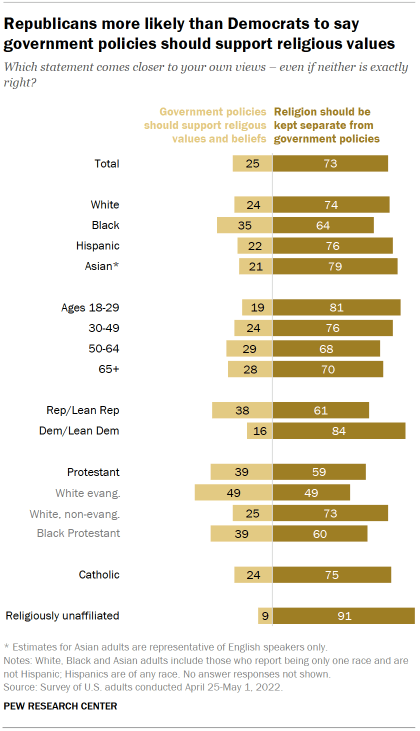
Nearly three-quarters of U.S. adults (73%) say religion should be kept separate from government policies, according to a survey conducted in spring 2022. Just 25% say government policies should support religious values and beliefs. While majorities of both Democrats and Democratic-leaning independents (84%) and Republicans and Republican leaners (61%) say religion should be kept separate from government policies, Republicans are far more likely to say government should support religious values (38% vs. 16%).
About four-in-ten Protestants (39%) say government policies should support religious values and beliefs, compared with 24% of Catholics and 9% of religiously unaffiliated adults – those who describe their religious identity as atheist, agnostic or nothing in particular. White evangelical Protestants are split, with 49% saying that government policies should support religious values and an identical share saying they should be kept separate from religion.
The Johnson Amendment limits political activity by religious organizations, and most Americans (70%) want churches and other houses of worship to stay out of politics, according to a 2021 analysis. Still, a survey conducted during the presidential race in July 2020 found that some U.S. adults who had attended religious services in the month prior or watched services online said they had heard sermons expressing support for then-President Donald Trump (9%) or then-candidate Joe Biden (6%), while others had heard sermons expressing opposition to Trump (7%) or Biden (4%). Meanwhile, four-in-ten had heard sermons discussing the importance of voting, protesting or other forms of political engagement.
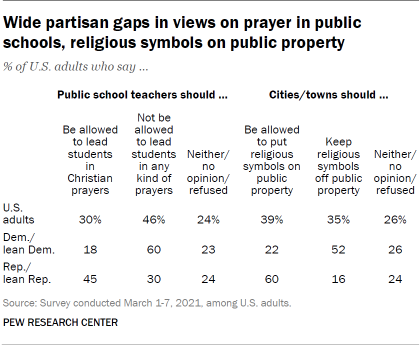
The Supreme Court ruled in 1962 that it’s unconstitutional for a teacher to lead a class in prayer at a public school, but three-in-ten U.S. adults said in a March 2021 survey that public school educators should be allowed to do this. A considerably larger share of Americans (46%) said teachers in public schools should not be allowed to lead students in any kind of prayers, with Democrats twice as likely as Republicans to say this (60% vs. 30%). Another 24% did not prefer either option.
Among U.S. public school students ages 13 to 17, 41% said in a 2019 survey that it’s appropriate for a teacher to lead a class in prayer, including 29% of teens who knew that this practice was banned but said it was acceptable nevertheless.
This year, the Supreme Court decided another case that involved prayer at public schools. In that case, the high court ruled that a high school football coach in Bremerton, Washington, had a constitutional right to pray at midfield following games.
Americans are divided on whether local governments should be allowed to put religious symbols on public property, according to the same March 2021 survey. Nearly four-in-ten U.S. adults (39%) say cities and towns should be allowed to do this, while 35% say religious symbols should be kept off public property. Roughly a quarter (26%) don’t favor either option. While some Supreme Court cases have determined that religious displays on government property are constitutional in certain contexts, other cases have found that such displays can be endorsements of religion, violating the First Amendment.
Christmas Day is the only federal holiday that’s also a religious holiday, although many Americans view Christmas as a cultural holiday, too. Congress made Christmas – along with the Fourth of July, Thanksgiving and New Year’s Day – an unpaid holiday for the federal D.C. workforce in 1870; a later bill extended these as paid vacation days for all government employees. Courts have upheld Christmas Day’s constitutionality, arguing that federal office closures do not coerce citizens to engage in religious activities. Efforts to recognize other religious holidays, such as Muslim Eid al-Fitr, have been unsuccessful to date.
Almost all U.S. presidents, including Joe Biden, have been Christian. Biden is only the second Catholic president (after John F. Kennedy), while the vast majority of others have been Protestant – most often Episcopalian or Presbyterian. Two of the most famous presidents, Thomas Jefferson and Abraham Lincoln, had no formal religious affiliation. Most presidents have been sworn in with a Bible, and they traditionally seal their oath of office with the phrase “so help me God.” Roughly half of Americans feel it is either very (20%) or somewhat (32%) important for a president to have strong religious beliefs (even if they are different from their own), according to a survey conducted in February 2020.
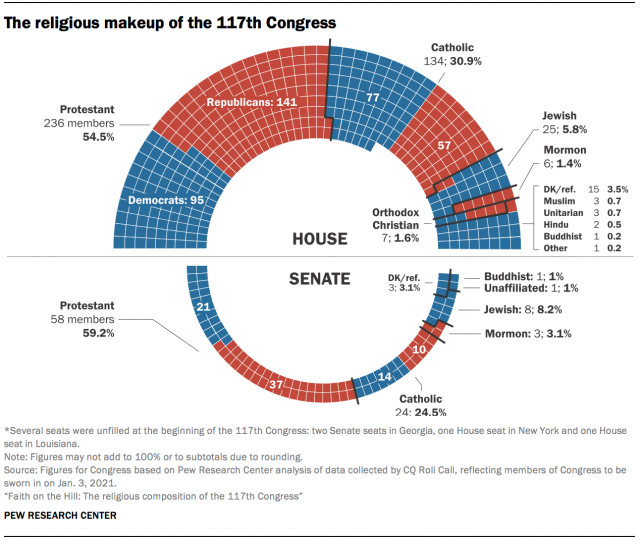
Congress has always been overwhelmingly Christian, and roughly nine-in-ten representatives (88%) in the current Congress – including 99% of Republicans and 78% of Democrats – identify as Christian, according to a January 2021 analysis. Congress is both more heavily Protestant than the U.S. population overall (55% vs. 40%) and more heavily Catholic (30% vs. 21%).
The Constitution guarantees that religion can never be a requirement for holding public office, but most Americans don’t know this, according to a 2019 Pew Research Center survey. When asked in a multiple choice question what the Constitution says about religion, only 27% of adults are able to correctly identify that “no religious test” is necessary to hold public office. Many U.S. adults incorrectly select that the Constitution requires federal officeholders to affirm that all men are endowed by their Creator with certain inalienable rights (15%), that the Constitution requires federal officeholders to be sworn in on the Holy Bible (12%), or that the Constitution says nothing about religion as it relates to federal officeholders (13%).Another 31% say they are not sure what the Constitution says about this.
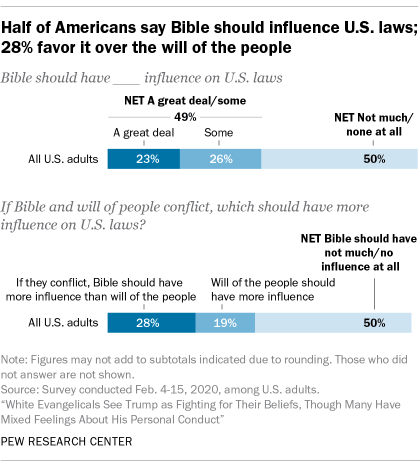
Americans are divided on the extent to which the country’s laws should reflect biblical teachings. Roughly half of adults say the Bible should influence U.S. laws either a great deal (23%) or some (26%), and more than a quarter (28%) say the Bible should prevail over the will of the people if the two are at odds, according to a February 2020 survey. Half of Americans, meanwhile, say the Bible shouldn’t influence U.S. laws much (19%) or at all (31%).
Note: This is an update of a post originally published July 16, 2020.



 Related video: Sen. Mitt Romney weighs in on Biden and Trump agreeing to debate (MSNBC)
 MSNBC