By Joel Litman, chief investment officer, Altimetry
The Christmas Miracle That Changed Banking Forever
By Joel Litman, chief investment officer, Altimetry
After a year and a half of fighting, Al de Molina’s bid to save General Motors hinged on a Christmas Miracle…
2008 was ending, and de Molina was trapped in a three-way standoff between the lending operation GMAC, the company’s bondholders, and the Federal Reserve.If de Molina lost this fight, GMAC would fold and take down the carmaker and thousands of local dealerships with it.De Molina’s journey began in August 2007, when he became the chief operating officer of GMAC. At the time, subprime lending markets were already cracking. The worst of the global financial crisis was still a year away. But many consumer-focused companies were already feeling real pain.And few felt it more than the auto industry… and GM especially.
Like many car companies, GM had long operated two businesses…
One division (GM) built and sold cars. The other half (GMAC) financed these vehicles.When someone bought a car from GM, GMAC would purchase the car from GM. It would then give the car to the consumer, who would pay GMAC over time through an auto loan.GM received the cash up front. GMAC took on the credit risk, and the consumer drove off happy.Although GMAC had spun off from GM in 2006, the companies’ fortunes were bound together. GM still owned 49% of the lending company and relied on loans going through GMAC.You see, GMAC also loaned capital to individual dealerships so they could stock their lots with GM cars.With so many loans being written all the time, GMAC didn’t have enough cash to lend to people. So it borrowed money from the bond market that it would turn around and lend out to dealerships and consumers.The formula worked great when the economy was working.
In 2007, though, it was a recipe for ruin…
GM’s sales would fall 17% in 2008… and 29% in 2009. As people stopped buying cars, GMAC wrote fewer loans. That meant it collected less interest income.It also meant less money for dealerships, which now struggled to pay back the loans they used to stock their lots.Consumers stopped buying… dealerships couldn’t pay their debts… and frozen credit markets meant GMAC couldn’t refinance its debt. The ripple effect threatened the end of a 100-year-old auto giant.Enter Al de Molina…De Molina wasn’t an auto-industry vet. But he knew finances. Prior to joining GMAC, de Molina spent 17 years at Bank of America, where he spent a year as CFO in 2006.He expected to parachute in, clean up GMAC’s operations, and move on.
But what was supposed to be a quick fix turned into anything but…
GMAC lost more than $2.3 billion in 2007… and was on track to lose $7.2 billion in 2008.By the time de Molina took over as GMAC’s CEO in March 2008, he realized the only way to save GMAC – and the thousands of dealers that relied on it – would be to turn the lender into a bank.Becoming a bank would allow GMAC to raise deposits and make it eligible for the government’s emergency bailout funds.It was a huge undertaking… And de Molina had nine months to make it happen.
On December 16, legendary market veteran Marc Chaikin is officially sounding the alarm on the U.S. stock market… and will reveal the No. 1 step to take with your money BEFORE January 1 to protect yourself and prepare as hundreds of stocks could soon suffer swift, brutal sell-offs. The last time he issued a warning like this, the average investor went on to lose up to 44% of their portfolio in the months that followed. Before it’s too late, learn more here.
As one market veteran is now warning, if you want to protect yourself from the chaos surrounding the AI bubble – and potentially triple your money – you need to make this ONE move before January 1, 2026.
GMAC was in a race against time. If the company didn’t secure cash by the year’s end, it would break loan covenants, potentially pushing it toward bankruptcy.With GMAC out of commission, GM and its dealers would fail. More than 85% of North American GM dealers would lose access to vital funding.
De Molina’s first challenge was to convince GMAC’s two shareholders to reduce their stake in the company…
Investment firm Cerberus Capital Management had to drop its 51% share to 33%. GM had to cut its stake from 49% to less than 10%.This was the easy part.The bigger challenge – GMAC needed a big injection of equity from somewhere.The Federal Reserve required banks to have specific amounts of cash or equity based on their outstanding debts. GMAC had too much debt and not enough equity or assets.By the fall of 2008, Lehman Brothers had collapsed, and private markets were closed… especially to companies facing bankruptcy. So a cash injection was off the table.It had one path to survival. The Fed told GMAC it needed to convert 75% of its $38 billion in bonds into equity. That was its only chance to qualify as a bank and save its business.But GMAC bondholders didn’t want to convert their bonds into shares of a failing company. GMAC argued that without the conversion, bondholders could lose everything.In the end, the Fed blinked.
On Christmas Eve, the central bank approved GMAC’s transformation into a bank… even without action from bondholders…
GMAC later said that it had converted only $21.2 billion worth of bonds into equity, about 52%.But that was enough. The newly minted bank ultimately received more than $17 billion in bailout funds by the end of 2009.GM eventually went bankrupt. But de Molina’s ability to keep GMAC afloat meant thousands of GM dealerships could stay open as the carmaker worked its way out of bankruptcy.Today, GM is once again one of the largest auto companies in the U.S. And GMAC is still around too, only it goes by the name Ally Financial (ALLY).Ally remained a full-fledged bank – with one catch…From its start, Ally had the institutional know-how and a solid foundation of borrowers. But it didn’t have a network of physical branches like traditional banks.
Rather than trying to play catch-up with legacy banks, Ally embraced its position…
It became one of the first fully digital, branchless banks.Companies like Ally have changed the rules of banking. No longer do banks need fancy lobbies and smiling tellers to attract new customers.Instead, they rely on user-friendly, comprehensive banking apps that can handle all of a customer’s money-related needs.Today, a solid banking app isn’t a “nice to have.” It’s a necessity. It doesn’t matter if you’re a tiny regional player… or a financial giant. Tech is non-optional in today’s banking industry.And the businesses that embrace it should outperform the rest.Let’s jump in.
Here we go again – WordPress is blocking me while I try to blog. Shame on you.
12/18/2025
The S&P 500 closed down 1.16% yesterday, marking four straight losing sessions for the index, which is now off 2.6%% from the all-time high it hit on Dec. 11. The decline was led, as usual, by technology stocks. Oracle was down 5.4% and its AI data center rival CoreWeave lost more than 7%.
Two things pummeled the tech sector:
First, “Big Short” investor Michael Burry published a chart from Wells Fargo on X showing that stocks now composed a greater portion of U.S. household wealth than real estate. That has happened only twice before in history, once in the 1960s and then again immediately before the dot com crash of 2000. “The last two times the ensuing bear market lasted years,” Burry said.
“Reasons for this are many but certainly include the gamification of stock trading, the nation’s gambling problem due to its own gamification, and a new ‘AI’ paradigm backed by trillions [of dollars] of ongoing planned capital investment backed by our richest companies and the political establishment. What could go wrong?” Burry argued.
Second, Oracle failed to close a deal for $10 billion in debt-based funding from Blue Owl Capital for a new AI data center in Michigan, according to the Financial Times. The company admitted it would not partner with Blue Owl but told the FT it was pressing ahead with the plan on schedule.
Wall Street is increasingly unimpressed with Oracle’s debt. “With over $100 billion in outstanding debt, investors continue to grow more concerned about the company’s borrowing to fund its AI ambitions,” Bespoke Investment Group told clients in an email this morning.
Jim Reid and his colleagues at Deutsche Bank noted that the spread on Oracle’s credit default swaps—the yield premium that investors demand for the risk of buying them—which was already notably wider than comparable companies, got even wider.
“That FT report … heightened concerns around a potential AI bubble, and meant that Oracle’s five-year credit default swaps climbed to 156 basis points, their highest since the GFC [Great Financial Crisis],” they said. “So tech stocks led yesterday’s declines, with the [Magnificent Seven tech stocks] (-2.12%) having its worst day in over a month, led by a -3.81% slump for Nvidia.”
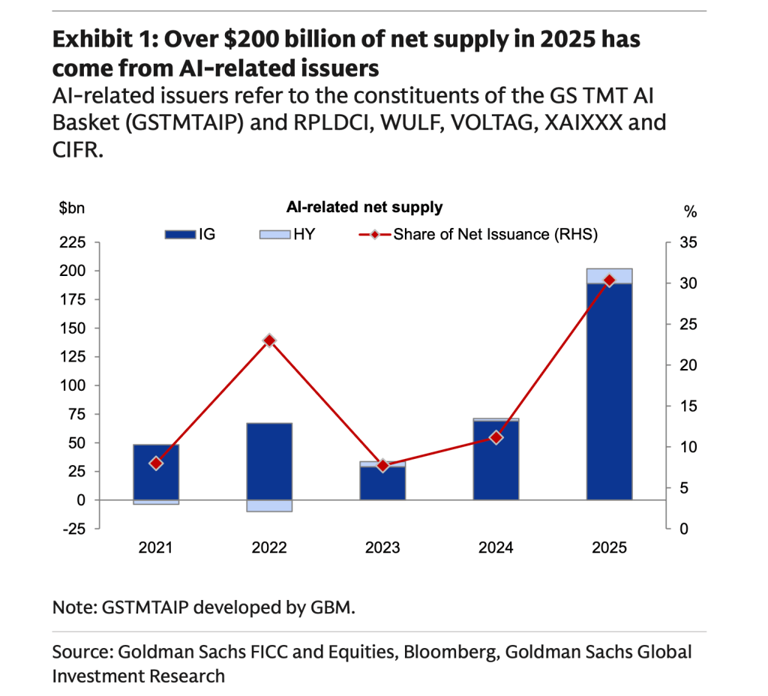
The net new supply of AI-related debt from all tech companies doubled this year to $200 billion, according to research by Goldman Sachs, and now accounts for 30% of all corporate debt issuance.
‘Big Short’ investor Michael Burry piles misery onto tech stocks after Oracle fails to close AI debt deal
KKR published its 2026 “outlook” yesterday and it was notably skeptical about AI data center construction. In a section titled “Speculative Data Center Projects with Uncompetitive Cost Structures,” the private equity company wrote: “We see some excess exuberance in data centers … estimates point to almost $7 trillion in global data center infrastructure capital expenditures by 2030, an amount roughly equal to the combined GDP of Japan and Germany. As always, unit economics are key. Developers who focus on return on invested capital after power, capital and maintenance capex costs will do well, while those who focus on theoretical total addressable markets and lose sight of unit economics are likely to suffer.”
Economist Ed Yardeni told clients that “The Mag-7 may be undergoing a correction.”
“In recent weeks, investors have started to fret that the spending is depleting the Mag-7s’ cash flows and slowing profits growth. Before AI, the Mag-7 had lots of cash flow because their spending on labor and capital was relatively low. That changed once AI forced them to spend much more on both,” he said.
“We aren’t ruling out a Santa Claus rally over the remainder of the year. However, that is unlikely to happen if the S&P 500 continues to rotate away from the Magnificent-7 toward the Impressive-493, as we expect.”
Michael Burry said he thinks the Fed’s latest update points to weakness in the US banking system.
He flagged the Fed’s plan to start purchasing short-term Treasurys as a sign of systemic weakness.
“So I’d say US Banks are getting weaker way too fast,” Burry wrote in a post on X.
Michael Burry thinks he’s spotted another sign of trouble in the US financial system.
The famed investor of “The Big Short” said he was eyeing one comment in particular that came out the Fed’s meeting on Wednesday. That’s the mention that the FOMC believes the Fed’s reserve balances had declined to “ample levels” — and that the central bank would start making “reserve management purchases.”
It’s a jargony way of saying the Fed will start purchasing short-term US Treasurys “on an ongoing basis,” per the committee’s statement Wednesday afternoon.
Purchasing short-term T-bills — which the Fed will start doing on December 12 and total around $40 billion a month — is one way the central bank can boost liquidity in markets and the banking sector. It’s slightly different from quantitative easing, which is when the Fed purchases long-term Treasurys to stimulate the economy by keeping a lid on borrowing costs. However, in the short term, it has a similar effect of boosting the amount of money circulating through the financial system, making it easier for banks to meet their reserve requirements.
But the fact that the Fed has to provide that support at all is a worrying sign, in Burry’s view. The Fed’s reserve balances currently hover around $2.8 trillion, according to the latest weekly data from the central bank.
“I would add if the US banking system can’t function without $3+ trillion in reserves/life support from the Fed, that is not a sign of strength but a sign of fragility,” Burry wrote in a post on X Wednesday evening. “So I’d say US Banks are getting weaker way too fast.”
The purchase of short-term Treasurys marks the first time the Fed has meaningfully expanded its balance sheet since it ended its quantitative easing prgram in 2022, analysts at Deutsche Bank said.
“Seems that after every crisis now the Fed needs to expand its balance sheet permanently or guarantee a bank funding crisis. No wonder stocks are doing well,” Burry said, adding that he was avoiding bank stocks and choosings to keep his money in cash accounts or Treasury money market funds.
“Rip QT; long live ‘reserve management purchases,'” he added.
Burry, who correctly called the subprime mortgage crisis, has cemented his reputation as a permabear in recent years. Since returning to social media this year, he has repeatedly sounded the alarm on a stock market bubble, unveiled fresh bets against AI titans like Nvidia, and warned about the huge amounts of spending by the biggest tech companies.
If you enjoyed this story, be sure to follow Business Insider on MSN.
As one of the few investors who bet against the housing market prior to the Great Recession, hedge fund manager Michael Burry became one of the more famous investors on Wall Street after being featured as one of the main characters in Michael Lewis’ highly acclaimed book, The Big Short. Later on, Christian Bale would portray Burry in the movie adaptation.
Despite his widespread notoriety, Burry has largely maintained a low profile, with minimal public appearances and sporadic tweets. Recently, though, Burry has made a big change, shutting down his fund, Scion Asset Management, and launching a Substack newsletter. Burry even recently did a podcast interview with Michael Lewis, which may have been his first public interview since he went on CBS’ 60 Minutes back in 2010.
No longer a fund manager, Burry isn’t pulling any punches — and his warning to Wall Street couldn’t be any clearer.
Market structure is a problem
During his interview with Lewis, Burry said he shut down Scion because he is worried about the stock market, which he believes could experience a prolonged downturn, a scenario he doesn’t want to have to relive while running a fund with investors.
During his bets against the housing market in the mid-to-late 2000s, Burry received significant pushback from his investors because he had to make monthly premium payments on the credit default swaps he purchased on mortgage bonds, which wouldn’t pay out until the bonds collapsed, a process that took several years to play out.
Even when Burry turned out to be right and made tremendous profits for his investors, during the recent interview, he said that nobody called to apologize, but also that he didn’t expect anyone to, either. Now, Burry seems mainly concerned not just about market froth and excessive exuberance over artificial intelligence, but also the structure of the stock market, which has shifted from more actively managed a few decades ago to being very passive.
Active investing refers to the process of conducting thorough research and frequently buying and selling stocks to outperform the market and generate alpha, as there are inefficiencies to capitalize on. Passive investing involves investing in a diversified basket of stocks that can replicate a broader index, and holding those stocks over a long-term period to reduce the costs associated with more frequent buying and selling of stocks.
Today, according to Burry, over half of the money invested in the stock market is passive. Meanwhile, less than 10% of money is being actively managed by managers who think long term, so things could be different this time around:
And so the problem is, in the United States, I think when the market goes down, it’s not like in 2000, where there was this other bunch of stocks that were being ignored, and they’ll come up even if the Nasdaq crashes. Now, I think the whole thing is just going to come down, and it will be very hard to be long stocks in the United States and protect yourself. And so that’s why I decided to get out.
Burry is not the only fund manager to raise this concern, and many of even the best managers say that value investing might be dead, due to this very reason. Historical data show that the market has consistently generated solid long-term returns and that investing in stocks is less risky when held for the long term. As a result, investors are more likely to passively invest and buy the dip, especially when the government and the Federal Reserve appear to always intervene to stabilize market conditions as they seem to be rapidly deteriorating.
The issue is that if people truly start to get scared and sell, it could have a cascading effect that would be difficult to escape. Just like the market has gone up and reached extremely high valuations, sometimes without any explanation, that effect could be just as penalizing when the market is going down.
Burry has also expressed skepticism regarding artificial intelligence, comparing it to the dot-com bubble of 2000, for several reasons, including the incredible capital expenditure by AI giants that may not yield good returns. Burry has also expressed concerns over accounting practices, in which he claims AI companies are inflating the useful life of chips and servers, thereby artificially lowering their annual depreciation expenses.
Steps retail investors can take to protect themselves
Burry is clearly one of the best investors in the game. However, there are other astute investors who disagree with Burry, and ultimately, retail investors are very unlikely to correctly time the market.
Investors with a 10-, 20-, or 30-year investing horizon ahead of them don’t necessarily need to take any action, as history suggests that the longer one holds stocks, the more likely they are to generate solid returns. However, if you are concerned, as Burry suggests, that passive investing has become a newer issue that the market may not be ready for, there are certain strategies one can take,
One option is to shift funds to a more conservative investment strategy, such as investing in an equal-weighted ETF following the S&P 500 index, which removes the weighting of stocks in the S&P 500 and therefore has less exposure to the high-flying AI companies. An equal-weighted ETF likely won’t dominate the way the normal S&P 500 has, but it should protect your downside more. Investors who own individual stocks may also want to look carefully at valuations, as Burry actually suggested.
If a stock you own has been a multi-bagger in a short period of time and now trades at a ridiculous multiple like 100 or 200 times forward earnings, it may be time to start trimming and taking some gains, at the very least. Just as investors can dollar-cost average into a stock or index, you can employ a similar strategy and sell a portion of your gains each month.
Should you invest $1,000 in S&P 500 Index right now?
Before you buy stock in S&P 500 Index, consider this:
The Motley Fool Stock Advisor analyst team just identified what they believe are the 10 best stocks for investors to buy now… and S&P 500 Index wasn’t one of them. The 10 stocks that made the cut could produce monster returns in the coming years.
Consider when Netflix made this list on December 17, 2004… if you invested $1,000 at the time of our recommendation, you’d have $499,978!* Or when Nvidia made this list on April 15, 2005… if you invested $1,000 at the time of our recommendation, you’d have $1,126,609!*
Now, it’s worth noting Stock Advisor’s total average return is 971% — a market-crushing outperformance compared to 195% for the S&P 500. Don’t miss out on the latest top 10 list, available when you join Stock Advisor.
One of the oldest tactics in war is to divide your enemy’s forces, be it mentally by subterfuge or physically with military tactics.
The strongest armies in the world aren’t nearly as effective when there is a genuine divide splitting the forces.
All good leaders know this simple fact — and are also acutely aware of the need to defend against it because of how effective it is.
The Margin Report·
President Donald Trump is approaching the one-year mark of his second term, and it’s been a lot of the same song and dance from his usual adversaries in the establishment media.
Namely, they’re still trying to denigrate the president and his team, clearly trying to sow — or at least create the impression of sowing — division in his cabinet.
CNN, a longtime adversary of Trump, put out a report recently declaring that many of his cabinet members are expecting some sort of turnover as he approaches one year in office. Some big names, like Secretary of War Pete Hegseth and Director of National Intelligence Tulsi Gabbard, were floated as those Trump was less than satisfied with.
MS NOW, formerly MSNBC, is another Trump nitpicker. That outlet came out with a report slamming Department of Homeland Security Secretary Kristi Noem, who the outlet said was on “very thin ice” with the administration.
Taken at face value, these reports would easily paint the picture of a fractured — and therefore ineffective — MAGA bas Trump, however, took umbrage with these characterizations and effectively drove a stake through the hearts of the nakedly divisive efforts from the establishment.
“I read a story that I was unhappy with Pete because he was attacking drug dealers,” Trump mentioned in a now-viral clip. “I said that’s not exactly right, I would say very much the opposite. Pete Hegseth has been phenomenal.
“I read a story recently that I’m unhappy with Kristi. I’m so happy with her. I mean, we have a closed border. We have a border that’s the best border in the history of our country. Why would I be unhappy? She’s fantastic, actually.
“We have a fantastic cabinet. Really fantastic cabinet.”
Trump did take a joking shot at U.S. Commerce Secretary Howard Lutnick, but it was obviously a joke and engendered some laughs.
Jokes? “Phenomenal” Pete? “The best border in the history of our country”?
These are not the quips of a leader worried about a fractured base.
Sorry, leftist media: It looks like you’ll have to try a different tactic to tear down the Trump administration.
Have you considered pushing candidates who are actually likable in elections?




 Money Talks News

 Fin Tek


 Slingshot News
