
05/02/2026
Yes, that is what Progressives, the former Democrats, give to their members. Growing up we called that “rot gut.”
****
ttps://www.msn.com/en-us/news/opinion/seattle-ai-founder-looks-to-leave-as-taxes-rise-everybody-that-i-know-is-in-the-process-of-leaving/ar-AA22eX38?ocid=msedgdhp&pc=DCTS&cvid=69f63a2646ca4a6fb69d64ce10e46a5a&ei=19
Seattle AI founder looks to leave as taxes rise, ‘Everybody that I know… is in the process of leaving’
Opinion by Rachel del Guidice

A Seattle AI startup founder says he’s preparing to leave the city as taxes rise, warning that many entrepreneurs are already heading for the exits.
“We’re out looking for an alternative,” Jesse Proudman, president and CTO of Venice.ai, a privacy-focused unrestricted generative AI platform, told Fox News Digital in an interview Friday.
“So we were looking in Nevada, we’re looking in Texas and Austin, we’re looking at Nashville and Florida,” Proudman said. “And these are climates where the business community is vibrant. They’re climates where the government is encouraging entrepreneurship, where they’re welcoming people, and they’re not villainizing those who have built something.”
Jesse Proudman receiving the Entrepreneur of the Year award in 2018. Fox News© Jesse Proudman
Proudman said he has been in Washington state for 28 years, and that Venice.ai is his third startup. He started his first company when he was 13.
“Seattle used to be a place where you were excited to build something, where it was celebrated, where you could imagine creating something from nothing and that you could manifest that,” Proudman said.
“And for many years, for probably 20 years, that was the culture here,” he added. “We had a vibrant startup community. We had a very supportive startup community. And the ecosystem worked. It helped build the companies. And then, for whatever reason, sort of over the last four or five years, we’ve seen this shift where entrepreneurship is now villainized. And it’s an unfortunate and sad shift in what otherwise has been a phenomenal place to run businesses.”
In March, Washington state Democrats passed the “millionaires tax,” which Democratic Gov. Bob Ferguson signed on March 30. It’s the state’s first-ever income tax, pushed by progressives and socialists and opposed by conservatives.
The Wall Street Journal editorial board called the new tax a “con” after its passage that will “inevitably capture the middle class.
Proudman told Fox News Digital that he has similar concerns.
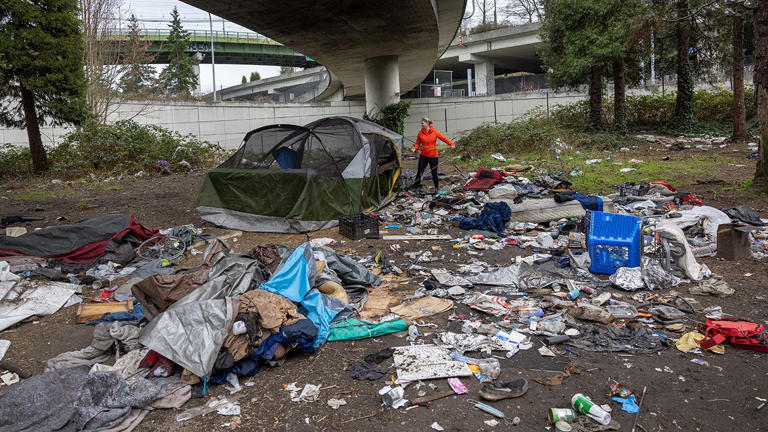
Andrea Suarez dismantles a tent at a homeless encampment with garbage piled around in Seattle, Washington, on March 13, 2022. Suarez is the executive director of We Heart Seattle, a nonprofit that organizes trash cleanups across the city amid rising homelessness during the COVID-19 pandemic. Getty Images© Getty Images
“They’re beginning with millionaires because that’s an easier place to sell it. It’s obvious that they intend to apply this to everybody,” he said.
Proudman said that his concern is that Washington state Sen. Jamie Pedersen, who sponsored the millionaires tax, intends to extend the tax beyond millionaires.
“He said he intends to apply it to everybody and, quite frankly, its implication is that Washington will become the highest tax state in the country,” Proudman said of Pedersen. “It doesn’t make sense to continue to live here if you have mobility.”
STEVE MOORE: DID ELON MUSK DRAIN THE SWAMP OR DROWN IN IT?
During a recent event at Seattle University, Mayor Katie Wilson, a self-described democratic socialist, laughed and appeared to dismiss the possibility that millionaires would leave the state.
“I think the claims that millionaires are going to leave our state are, like, super overblown. And if — the ones that leave, like, bye,” Wilson said.
Proudman sees a more stark situation.
“The reality is everybody that I know that has means to leave has either left or is in the process of leaving,” he said.
TAX FIGHT PUTS CALIFORNIA ON COLLISION COURSE AS BILLIONAIRES LEAVE FOR RED STATES
A city worker picks up trash next to graffiti on 4th Avenue in Seattle, Washington, on March 9, 2022. Getty Images© Getty Images
“They’ve listed their homes, they’re shopping elsewhere,” Proudman continued. “And again, it’s like, you don’t want to be where you’re not part of the community, where it doesn’t feel like you’re welcome. And so the mayor, whose job it is, is to build a vibrant city, is telling the people who have built companies here, who have created jobs in this city and this state that they’re not wanted here.”
“It’s the same thing that happened in California with Elon Musk,” he added. “Again, he went to Texas. Like, you’re not wanted, you’ll move to a climate where you are.”According to the Tax Foundation, the city of Seattle has the highest combined state and local sales tax rate, at 10.35%.

A homeless man holds a piece of aluminum foil he used to smoke fentanyl in Seattle, Washington, on March 13, 2022. Getty Images© Getty Images
Fox News Digital reached out to Wilson and Pedersen for comment but did not immediately receive responses.
Original article source: Seattle AI founder looks to leave as taxes rise, ‘Everybody that I know… is in the process of leaving’
kommonsentsjane

