
Here we go again – WordPress is blocking me while I try to blog. Shame on you.
12/18/2025
The S&P 500 closed down 1.16% yesterday, marking four straight losing sessions for the index, which is now off 2.6%% from the all-time high it hit on Dec. 11. The decline was led, as usual, by technology stocks. Oracle was down 5.4% and its AI data center rival CoreWeave lost more than 7%.
Two things pummeled the tech sector:
First, “Big Short” investor Michael Burry published a chart from Wells Fargo on X showing that stocks now composed a greater portion of U.S. household wealth than real estate. That has happened only twice before in history, once in the 1960s and then again immediately before the dot com crash of 2000. “The last two times the ensuing bear market lasted years,” Burry said.
“Reasons for this are many but certainly include the gamification of stock trading, the nation’s gambling problem due to its own gamification, and a new ‘AI’ paradigm backed by trillions [of dollars] of ongoing planned capital investment backed by our richest companies and the political establishment. What could go wrong?” Burry argued.
Of course, Burry has a conflict of interest in the form of a $1.1 billion short bet against AI stocks Palantir and Nvidia. So take his doom-mongering with a pinch of salt.
Second, Oracle failed to close a deal for $10 billion in debt-based funding from Blue Owl Capital for a new AI data center in Michigan, according to the Financial Times. The company admitted it would not partner with Blue Owl but told the FT it was pressing ahead with the plan on schedule.
Wall Street is increasingly unimpressed with Oracle’s debt. “With over $100 billion in outstanding debt, investors continue to grow more concerned about the company’s borrowing to fund its AI ambitions,” Bespoke Investment Group told clients in an email this morning.
Jim Reid and his colleagues at Deutsche Bank noted that the spread on Oracle’s credit default swaps—the yield premium that investors demand for the risk of buying them—which was already notably wider than comparable companies, got even wider.
“That FT report … heightened concerns around a potential AI bubble, and meant that Oracle’s five-year credit default swaps climbed to 156 basis points, their highest since the GFC [Great Financial Crisis],” they said. “So tech stocks led yesterday’s declines, with the [Magnificent Seven tech stocks] (-2.12%) having its worst day in over a month, led by a -3.81% slump for Nvidia.”
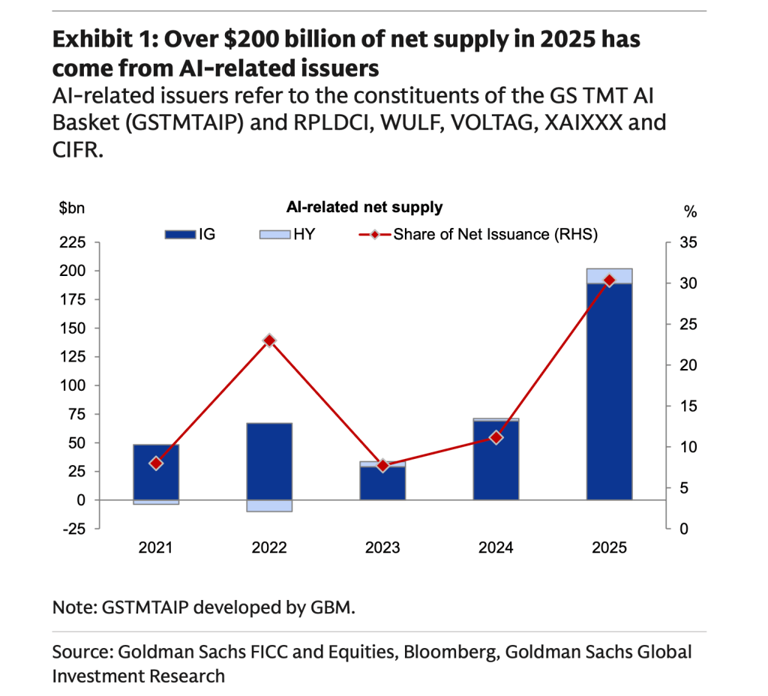
The net new supply of AI-related debt from all tech companies doubled this year to $200 billion, according to research by Goldman Sachs, and now accounts for 30% of all corporate debt issuance.
‘Big Short’ investor Michael Burry piles misery onto tech stocks after Oracle fails to close AI debt deal
KKR published its 2026 “outlook” yesterday and it was notably skeptical about AI data center construction. In a section titled “Speculative Data Center Projects with Uncompetitive Cost Structures,” the private equity company wrote: “We see some excess exuberance in data centers … estimates point to almost $7 trillion in global data center infrastructure capital expenditures by 2030, an amount roughly equal to the combined GDP of Japan and Germany. As always, unit economics are key. Developers who focus on return on invested capital after power, capital and maintenance capex costs will do well, while those who focus on theoretical total addressable markets and lose sight of unit economics are likely to suffer.”
Economist Ed Yardeni told clients that “The Mag-7 may be undergoing a correction.”
“In recent weeks, investors have started to fret that the spending is depleting the Mag-7s’ cash flows and slowing profits growth. Before AI, the Mag-7 had lots of cash flow because their spending on labor and capital was relatively low. That changed once AI forced them to spend much more on both,” he said.
“We aren’t ruling out a Santa Claus rally over the remainder of the year. However, that is unlikely to happen if the S&P 500 continues to rotate away from the Magnificent-7 toward the Impressive-493, as we expect.”
The “the Impressive-493” is a reference to all the other stocks in the S&P 500 outside the Magnificent Seven which have done pretty well this year.
ttps://www.msn.com/en-us/money/savingandinvesting/big-short-investor-michael-burry-piles-misery-onto-tech-stocks-after-oracle-fails-to-close-ai-debt-deal/ar-AA1SB2w7?ocid=msedgdhp&pc=DCTS&cvid=69440c80a40043ef8d4a40fad6c1e435&ei=20
****
12/12/2025
ttps://www.msn.com/en-us/money/markets/big-short-investor-michael-burry-says-the-latest-fed-meeting-points-to-trouble-in-the-banking-system/ar-AA1Sa4ZI?ocid=msedgdhp&pc=DCTS&cvid=693b7182b66041ceb9a4c4af82ae10dd&ei=20
‘Big Short’ investor Michael Burry says the latest Fed meeting points to trouble in the banking system
Story by jsor@businessinsider.com (Jennifer Sor)

Jim Spellman/WireImage© Jim Spellman/WireImage
- Michael Burry said he thinks the Fed’s latest update points to weakness in the US banking system.
- He flagged the Fed’s plan to start purchasing short-term Treasurys as a sign of systemic weakness.
- “So I’d say US Banks are getting weaker way too fast,” Burry wrote in a post on X.
Michael Burry thinks he’s spotted another sign of trouble in the US financial system.
The famed investor of “The Big Short” said he was eyeing one comment in particular that came out the Fed’s meeting on Wednesday. That’s the mention that the FOMC believes the Fed’s reserve balances had declined to “ample levels” — and that the central bank would start making “reserve management purchases.”
It’s a jargony way of saying the Fed will start purchasing short-term US Treasurys “on an ongoing basis,” per the committee’s statement Wednesday afternoon.
Purchasing short-term T-bills — which the Fed will start doing on December 12 and total around $40 billion a month — is one way the central bank can boost liquidity in markets and the banking sector. It’s slightly different from quantitative easing, which is when the Fed purchases long-term Treasurys to stimulate the economy by keeping a lid on borrowing costs. However, in the short term, it has a similar effect of boosting the amount of money circulating through the financial system, making it easier for banks to meet their reserve requirements.
But the fact that the Fed has to provide that support at all is a worrying sign, in Burry’s view. The Fed’s reserve balances currently hover around $2.8 trillion, according to the latest weekly data from the central bank.

The Fed said it would start purchasing short-term Treasury bills this week. Justin Sullivan/Getty Images© Justin Sullivan/Getty Images
“I would add if the US banking system can’t function without $3+ trillion in reserves/life support from the Fed, that is not a sign of strength but a sign of fragility,” Burry wrote in a post on X Wednesday evening. “So I’d say US Banks are getting weaker way too fast.”
Stocks surged after the Fed’s policy meeting, largely fueled by optimism about the central bank’s plan to purchase short-term Treasury bills, JPMorgan’s market intelligence team wrote in a note.Related video: Jeffrey Gundlach sees $22 trillion private credit market heading toward crisis (Money Talks News)

Jeffrey Gundlach sees $22 trillion private credit market heading toward crisis.
The purchase of short-term Treasurys marks the first time the Fed has meaningfully expanded its balance sheet since it ended its quantitative easing prgram in 2022, analysts at Deutsche Bank said.
“Seems that after every crisis now the Fed needs to expand its balance sheet permanently or guarantee a bank funding crisis. No wonder stocks are doing well,” Burry said, adding that he was avoiding bank stocks and choosings to keep his money in cash accounts or Treasury money market funds.
“Rip QT; long live ‘reserve management purchases,'” he added.
Burry, who correctly called the subprime mortgage crisis, has cemented his reputation as a permabear in recent years. Since returning to social media this year, he has repeatedly sounded the alarm on a stock market bubble, unveiled fresh bets against AI titans like Nvidia, and warned about the huge amounts of spending by the biggest tech companies.
If you enjoyed this story, be sure to follow Business Insider on MSN.
****
12/11/2025
ttps://www.msn.com/en-us/money/savingandinvesting/michael-burry-of-the-big-short-is-no-longer-pulling-any-punches-and-his-warning-to-wall-street-couldn-t-be-any-clearer/ar-AA1SaZV4?ocid=msedgdhp&pc=DCTS&cvid=693b6577a74e48ebb906c2140db56dc3&ei=17
Michael Burry of “The Big Short” is no longer pulling any punches — and his warning to Wall Street couldn’t be any clearer
Story by Bram Berkowitz
Key Points
- Michael Burry recently closed down his fund and launched a newsletter on Substack.
- Burry is concerned about the current state of the stock market.
- The famed investor also recently discussed how market structure has changed, and how that could impact a downturn differently than in the past.
- 10 stocks we like better than S&P 500 Index

As one of the few investors who bet against the housing market prior to the Great Recession, hedge fund manager Michael Burry became one of the more famous investors on Wall Street after being featured as one of the main characters in Michael Lewis’ highly acclaimed book, The Big Short. Later on, Christian Bale would portray Burry in the movie adaptation.
Despite his widespread notoriety, Burry has largely maintained a low profile, with minimal public appearances and sporadic tweets. Recently, though, Burry has made a big change, shutting down his fund, Scion Asset Management, and launching a Substack newsletter. Burry even recently did a podcast interview with Michael Lewis, which may have been his first public interview since he went on CBS’ 60 Minutes back in 2010.
No longer a fund manager, Burry isn’t pulling any punches — and his warning to Wall Street couldn’t be any clearer.

Market structure is a problem
During his interview with Lewis, Burry said he shut down Scion because he is worried about the stock market, which he believes could experience a prolonged downturn, a scenario he doesn’t want to have to relive while running a fund with investors.
During his bets against the housing market in the mid-to-late 2000s, Burry received significant pushback from his investors because he had to make monthly premium payments on the credit default swaps he purchased on mortgage bonds, which wouldn’t pay out until the bonds collapsed, a process that took several years to play out.
Related video: Warren Buffett’s Advice to Investors for 2026 (Fin Tek)

More videos
- Fox BusinessInvestment CEO explains what people ‘don’t understand’ about stock buying3:38
- Cooper Academy“This Is A Sign Of A Bubble” (Charlie Munger)10:40
Even when Burry turned out to be right and made tremendous profits for his investors, during the recent interview, he said that nobody called to apologize, but also that he didn’t expect anyone to, either. Now, Burry seems mainly concerned not just about market froth and excessive exuberance over artificial intelligence, but also the structure of the stock market, which has shifted from more actively managed a few decades ago to being very passive.
Active investing refers to the process of conducting thorough research and frequently buying and selling stocks to outperform the market and generate alpha, as there are inefficiencies to capitalize on. Passive investing involves investing in a diversified basket of stocks that can replicate a broader index, and holding those stocks over a long-term period to reduce the costs associated with more frequent buying and selling of stocks.
Today, according to Burry, over half of the money invested in the stock market is passive. Meanwhile, less than 10% of money is being actively managed by managers who think long term, so things could be different this time around:
And so the problem is, in the United States, I think when the market goes down, it’s not like in 2000, where there was this other bunch of stocks that were being ignored, and they’ll come up even if the Nasdaq crashes. Now, I think the whole thing is just going to come down, and it will be very hard to be long stocks in the United States and protect yourself. And so that’s why I decided to get out.
Burry is not the only fund manager to raise this concern, and many of even the best managers say that value investing might be dead, due to this very reason. Historical data show that the market has consistently generated solid long-term returns and that investing in stocks is less risky when held for the long term. As a result, investors are more likely to passively invest and buy the dip, especially when the government and the Federal Reserve appear to always intervene to stabilize market conditions as they seem to be rapidly deteriorating.
The issue is that if people truly start to get scared and sell, it could have a cascading effect that would be difficult to escape. Just like the market has gone up and reached extremely high valuations, sometimes without any explanation, that effect could be just as penalizing when the market is going down.
Burry has also expressed skepticism regarding artificial intelligence, comparing it to the dot-com bubble of 2000, for several reasons, including the incredible capital expenditure by AI giants that may not yield good returns. Burry has also expressed concerns over accounting practices, in which he claims AI companies are inflating the useful life of chips and servers, thereby artificially lowering their annual depreciation expenses.
Steps retail investors can take to protect themselves
Burry is clearly one of the best investors in the game. However, there are other astute investors who disagree with Burry, and ultimately, retail investors are very unlikely to correctly time the market.
Investors with a 10-, 20-, or 30-year investing horizon ahead of them don’t necessarily need to take any action, as history suggests that the longer one holds stocks, the more likely they are to generate solid returns. However, if you are concerned, as Burry suggests, that passive investing has become a newer issue that the market may not be ready for, there are certain strategies one can take,
One option is to shift funds to a more conservative investment strategy, such as investing in an equal-weighted ETF following the S&P 500 index, which removes the weighting of stocks in the S&P 500 and therefore has less exposure to the high-flying AI companies. An equal-weighted ETF likely won’t dominate the way the normal S&P 500 has, but it should protect your downside more. Investors who own individual stocks may also want to look carefully at valuations, as Burry actually suggested.
If a stock you own has been a multi-bagger in a short period of time and now trades at a ridiculous multiple like 100 or 200 times forward earnings, it may be time to start trimming and taking some gains, at the very least. Just as investors can dollar-cost average into a stock or index, you can employ a similar strategy and sell a portion of your gains each month.
Should you invest $1,000 in S&P 500 Index right now?
Before you buy stock in S&P 500 Index, consider this:
The Motley Fool Stock Advisor analyst team just identified what they believe are the 10 best stocks for investors to buy now… and S&P 500 Index wasn’t one of them. The 10 stocks that made the cut could produce monster returns in the coming years.
Consider when Netflix made this list on December 17, 2004… if you invested $1,000 at the time of our recommendation, you’d have $499,978!* Or when Nvidia made this list on April 15, 2005… if you invested $1,000 at the time of our recommendation, you’d have $1,126,609!*
Now, it’s worth noting Stock Advisor’s total average return is 971% — a market-crushing outperformance compared to 195% for the S&P 500. Don’t miss out on the latest top 10 list, available when you join Stock Advisor.
****
Michael Burry warns of hidden billion dollar losses in the tech sector | Watch
ttps://www.msn.com/en-us/money/economy/michael-burry-warns-of-hidden-billion-dollar-losses-in-the-tech-sector/vi-AA1RY1Re?ocid=msedgdhp&pc=DCTS&cvid=99bfa724111c43e8c98e4723689cec40&ei=4

Michael Burry warns of hidden billion dollar losses in the tech sector
Michael Burry warns of hidden billion dollar losses in the tech sector.
kommonsentsjane

 kommonsentsjane