
10/12/2025
A divided Supreme Court ruled Friday that individual federal judges do not have the authority to issue nationwide injunctions, delivering a procedural victory for President Donald Trump while leaving unresolved the future of his attempt to restrict birthright citizenship.
In a 6-3 vote, the Court said lower courts should not issue nationwide injunctions which go beyond relief for individual plaintiffs on cases, while justices made it clear they were not issuing an opinion on birthright citizenship itself.
“First, the Court does not address the weighty issue whether the state plaintiffs have third-party standing to assert the Citizenship Clause claims of their individual residents,” Justice Samuel Alito wrote in his concurring opinion.
Why It Matters
The ruling marks a win for Trump, who has frequently criticized lower court judges for blocking his policies on a broad scale. However, the court’s conservative majority stopped short of allowing the executive order to immediately take effect nationwide, meaning the fate of the policy remains uncertain.
What To KnowAs the case made its way to the Court, concerns were raised around limiting nationwide injunctions, particular when it comes to immigration status. The libertarian Cato Institute told Newsweek in May that only allowing a ban on birthright citizenship in some states, but not others, could cause chaos for immigrant families crossing state lines.
The ruling is a victory for three Planned Parenthood affiliates
The Trump administration has said children of noncitizens are not “subject to the jurisdiction” of the U.S., as phrased in the 14th Amendment, and therefore do not qualify for automatic citizenship.
Critics, including immigrant rights groups and numerous state governments, contend the order is an attempt to undermine constitutional protections that have been settled for over a century. Lower courts have consistently blocked the administration’s policy, prompting the Department of Justice (DOJ) to challenge not only the legal basis of those rulings but also their nationwide scope.
Supreme Court Birthright Citizenship Decision: What’s New
In its defense, the DOJ asked the Supreme Court to limit the reach of any injunction to only the individuals and states directly involved in awsuits. Failing that, they requested the order remain blocked only in the 22 states that sued, with other jurisdictions free to enforce the policy.
As a fallback, the administration also sought permission to begin public communications on how the policy would be implemented, should it eventually be upheld. For now, the policy’s legality—and its future enforcement—remain in limbo.
The majority conservative justices said Friday that it was the Court, which has the power to decide on nationwide restrictions to federal government policies, and that the use of universal injunctions by lower courts had gotten out of hand in recent years.
In his concurring opinion, Justice Brett Kavanaugh laid out what he believed was the correct timeline, set out by decades of precedent, that if a party loses in a lower court, they can take it to appeal and, eventually, the Supreme Court.
“After today’s decision, that order of operations will not change,” Kavanaugh wrote. “In justiciable cases, this Court, not the district courts or courts of appeals, will often still be the ultimate decisionmaker as to the interim legal status of major new federal statutes and executive actions—that is, the interim legal status for the several-year period before a final decision on the merits.”
In a forceful dissent, liberal Justice Sonia Sotomayor accused the Supreme Court majority of enabling the government to sidestep constitutional protections in its ruling on birthright citizenship.
Sotomayor warned that the decision—limiting the scope of lower court injunctions—creates a legal regime where “no right is safe,” allowing unlawful policies to remain in effect for anyone not directly involved in a lawsuit. She cautioned that future administrations could exploit this precedent to restrict gun rights or religious freedoms.
Justice Ketanji Brown Jackson echoed Sotomayor’s concerns in a separate solo dissent, calling the ruling “an existential threat to the rule of law.” She criticized the majority’s reliance on 18th-century judicial norms as a “smokescreen” for granting the executive branch unchecked power.
What Has Donald Trump Said About Birthright Citizenship?
The president has been vocal in his beliefs that birthright citizenship has been abused and needs reigning in.
In a 2023 campaign video, Trump said: “On Day One of my new term in office, I will sign an executive order making clear to federal agencies that under the correct interpretation of the law, going forward, the future children of illegal immigrants will not receive automatic U.S. citizenship.”
Following November’s presidential election, there had been some fears that the incoming administration would seek to revoke the citizenship status granted to babies of undocumented immigrants in the past, but that appeared to be unfounded.
In January, Trump signed an executive order titled “Protecting The Meaning and Value of American Citizenship”, which prompted the legal challenges discussed by the Supreme Court.
In that order, Trump made it clear that the ban on birthright for children born to undocumented immigrants or visitors would only apply 30 days after the order took effect.
What Is Birthright Citizenship?
Even though the Court case is about injunctions, at the center is the issue of whether anyone born in the U.S. is considered an American citizen or not, and what exactly the 14th Amendment says, or doesn’t say, to define birthright.
Scholars, immigrants’ rights groups, and 183 Democratic members of Congress had all submitted additional filings arguing for birthright to remain as-is, applicable to all born here, regardless of a parent’s immigration status.
Trump’s executive order seeks to deny U.S. citizenship to children born on American soil to undocumented immigrants, challenging the long-standing interpretation of the 14th Amendment. Ratified after the Civil War, the amendment guarantees birthright citizenship—also known as jus soli, or “right of the soil”—to nearly all individuals born in the U.S.
The 1898 landmark decision United States v. Wong Kim Ark upheld this principle, carving out exceptions only for children of diplomats, hostile occupiers, or sovereign Native tribes. Today, about 30 countries, including Canada and Mexico, still follow this rule.
For Trump, and those who back his efforts to limit the right, the argument has been that five words in the 14th Amendment—”subject to the jurisdiction thereof”—suggest that citizenship should only be granted in cases where the parents have pledged some allegiance to the U.S., such as becoming citizens themselves or through seeking a green card.
Part of the argument from those seeking restrictions to birthright is that reducing access to birthright would dissuade some immigrants from trying to reach the U.S. to give birth, therefore cutting the undocumented population.
The Migration Policy Institute, a non-partisan organization, suggested in May that the opposite outcome was more likely. The group estimated that should birthright end, the number of illegal immigrants would grow by 2.7 million by 2045, and 5.4 million by 2075, because of the number of children born on U.S. soil to undocumented parents would stay the same, though those people would now be considered to be here without protections or status.
As Newsweek previously reported, it is extremely difficult to track which babies were born with birthright citizenship protections each year. While MPI estimates the number to be around a quarter million every year, Census and Centers for Disease Control and Prevention (CDC) data sets do not go deep enough, and hospitals generally do not ask expecting mothers for their immigration status.
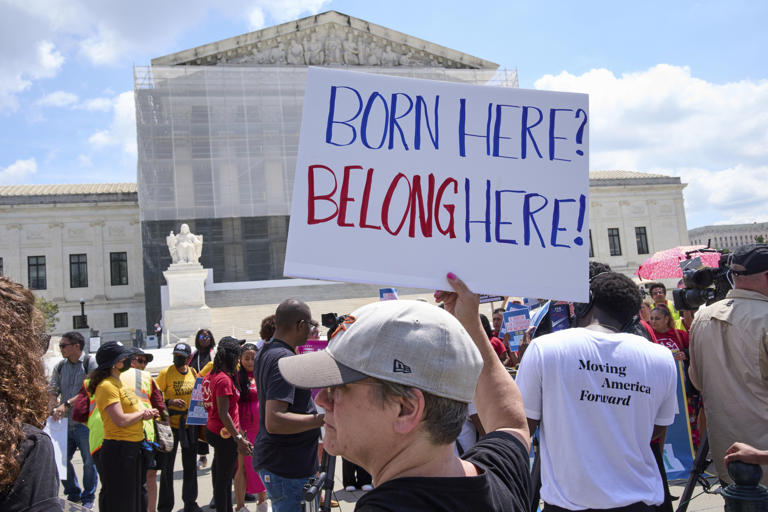
Jenny Harris, of Baltimore, protests in support of birthright citizenship and the immigrant community, Thursday, May 15, 2025, outside of the Supreme Court in Washington. AP Photo/Jacquelyn Martin© AP Photo/Jacquelyn Martin
What Percentage of Americans Are Natural-born Citizens?
It is extremely difficult to get a definitive number on how many birthright babies are born each year.
As Newsweek previously reported, the number of babies born to foreign-born moms has hovered around the 800,000 mark for the past decade. As federal government data does not give a greater level of detail, this is largely the number analysts and government agencies have to work with.
“If you’re parsing through U.S. census data and trying to get a sense of the number of kids who qualified for birthright citizenship, you are looking at not just the number of U.S. citizen children with at least one undocumented parent, but also children of temporary visa holders, legal permanent residents, and other mixed-status families,” Nan Wu, Director of Research at the American Immigration Council, told Newsweek in March.
The latest U.S. Census Bureau data showed 281,385,809 American-born U.S. citizens at last estimates, out of 334,914,896 total population. Around 22.8 million were not U.S. citizens.
What People Are Saying
U.S. Attorney General Pam Bondi, writing on X, formerly Twitter: “Today, the Supreme Court instructed district courts to STOP the endless barrage of nationwide injunctions against President Trump. This would not have been possible without tireless work from our excellent lawyers @TheJusticeDept and our Solicitor General John Sauer.”
President Donald Trump wrote on Truth Social: “GIANT WIN in the United States Supreme Court! Even the Birthright Citizenship Hoax has been, indirectly, hit hard. It had to do with the babies of slaves (same year!), not the SCAMMING of our Immigration process.”
Aaron Reichlin-Melnick, senior fellow at the American Immigration Council, wrote on X: “The Supreme Court is about to go on an extended summer vacation, after having blown up the docket of every single lower court judge.”
Democratic Pennsylvania state Representative Malcolm Kenyatta wrote on X: “This current Supreme Court is disgraceful.”
What Happens Next
The Court’s ruling allows the Trump administration to issue guidance on how the executive order on birthright citizenship can be implemented, which can now happen in 30 days.
The executive order could still face challenges, with at least two attempts at class action lawsuits filed later Friday.
One came in the form of an updated complaint in Casa Inc. v. Trump, one of the cases before the Supreme Court. Another was in a new suit filed by the American Civil Liberties Union (ACLU) in New Hampshire, with the group making it clear it was seeking relief for all families across the U.S.
This article includes reporting by The Associated Press.
Update 6/27/25, 11:21 a.m. ET: This article was updated with additional information and remarks.
Update 6/27/25, 4:13 p.m. ET: This article was updated with additional information.
kommonsentsjane

 kommonsentsjane