
02/16/2025
ttps://www.msn.com/en-us/news/us/ntsb-releases-new-details-on-d-c-midair-collision/vi-AA1z5Elq?ocid=msedgdhp&pc=U531&cvid=434e247d37794dd1a3624816ded3d360&ei=29
if the helicopter itself was giving the pilots bad data

 Click to unmute
NTSB releases new details on D.C. midair collision
The National Transportation Safety Board Friday laid out new details on its investigation into a midair collision between an American Airlines flight and a Black Hawk helicopter last month which killed 67 people. The NTSB said the chopper may not have heard instructions from an air traffic controller to pass behind the plane. Kris Van Cleave has more…
02/14/2025
ttps://www.msn.com/en-us/news/us/black-hawk-pilots-missed-key-message-before-d-c-plane-collision/ar-AA1z4SGc?ocid=msedgdhp&pc=U531&cvid=f61fb7bf56924099a5fe9c3d7058aac6
Kayla Bartkowski
Military helicopter pilots on a training flight over Washington, D.C., did not hear air traffic control directions to pass behind a passenger jet heading its way, investigators revealed on Friday.
With American Airlines Flight 5342 from Wichita, Kan., descending to land at Ronald Reagan Washington National Airport, the control tower warned the Black Hawk pilots to “pass behind” the looming aircraft seconds before the Jan. 29 midair collision.
But according to National Transportation Safety Board Chair Jennifer Homendy, the words “pass behind the” were cut from the transmission to the cockpit of the military chopper.
The collision between a passenger jet and a military helicopter over the Potomac River claimed 67 lives. / Andrew Caballero-Reynolds/AFP via Getty Images
She said it wasn’t known why communication in the cockpit cut out or why those vital instructions were “not communicated” to the copter pilots.
The mystery is one of the leads NTSB is investigating in its attempt to discover the cause of the crash that killed 67 people when the Mitsubishi Bombardier passenger plane collided with a U.S. Army Sikorsky UH-60 Black Hawk above the Potomac River. It was America’s worst air crash since November 12, 2001, when 260 people died when a plane smashed into a New York neighborhood. Another five people were killed on the ground.
Homendy said investigators were also trying to determine whether there was confusion onboard the helicopter about its altitude around the time of the crash and if the pilots’ wearing night-vision goggles had any bearing on their final moments.
In a second-by-second description, Homendy said there was an instructor pilot in the chopper carrying out an annual test on his fellow flyer as well as a night-vision exam.
They were using routes regularly employed by military craft over the Potomac, but investigators learned that at one point a couple of minutes before the collision, the pilot reported a height of 300 feet while the instructor said it was at 400 feet. “We don’t know why there was that discrepancy,” she said.
The radio tower appeared to alert the helicopter that oncoming traffic was “in sight” and passed on instructions to avoid it.
Until the final transmission to the helicopter, both the plane and helicopter pilots could hear instructions from the control tower, but couldn’t hear each other’s responses.
Related video: D.C. Tragedy: ADSB System Disabled in Fatal Air Collision (Morning Rush (Video)
D.C. Tragedy: ADSB System Disabled in Fatal Air Collision.
A “traffic, traffic” alert was passed on to the helicopter pilots with a message to pass behind the jet. It is this message, or at least part of it, that never reached the pilots.
Seven seconds before impact, the Black Hawk crew said it had “traffic in sight.” At that time, the copter was at 278 feet, but the NTSB accepts there may have been “conflicting information in the data.”
They said the altitude the pilots saw in their cockpit may not have been accurate.
“We will be investigating into what the Black Hawk pilots could and could not see,” said Momendy, who said there may be a number of reasons, including a malfunction of the altimeter on board the chopper.
“We are looking at the possibility that there may have been bad data where they saw something different inside the cockpit,” she added.
Investigators will also be looking into whether the night goggles used for the visibility study were a factor, she said.
****
02/08/2025
D.C Plane Crash Investigation Explained: All the Answers to Your Key Questions
Important details have emerged, including that the Black Hawk helicopter was flying too high and the passenger plane apparently tried to pull out of landing at the last second.
BY:
Published on February 6, 2025 01:57PM EST
- Data from the black boxes will help authorities create a “detailed timeline” of how an American Airlines jet and an Army helicopter collided on Jan. 29, killing 67 people
- A few key details and questions have emerged about the helicopter’s actions before slamming into the plane
- Government officials have vowed to “get to the bottom” of what went wrong
With black boxes in hand, investigators are now focusing on the actions of American Airlines Flight 5342 and an Army helicopter before they collided last week over the Potomac River in Washington, D.C., killing 67 people in a historic disaster.
The National Transportation Safety Board said that the data from both crafts — pulled from what’s known as their flight data and cockpit voice recorders — as well as radar records and the communications from air traffic controllers will allow for a “detailed timeline” of how the crash unfolded late on Jan. 29, just outside Ronald Reagan Washington National Airport.
“Imagine you had two cars that crashed at an intersection, and they had cameras on,” Laurie Garrow, an aviation expert at the Georgia Institute of Technology, tells PEOPLE. “With the recorders, they’re trying to reconstruct second by second where things were happening.”
At the same time, a few key details have emerged.
Officials say the helicopter was flying far too high during a routine night mission and had been twice warned about the jet, which was instructed just a few minutes before landing to switch runways.
Air traffic control staffing levels were also reportedly lower than they normally would have been. And at the last second, the passenger plane pulled up — as though trying to avert catastrophe.
Here are the latest questions and answers as the investigation continues.
What will the black boxes show?
Divers pulled the plane’s cockpit voice recorder and flight data recorder from the wreckage in the Potomac on Jan. 30, NTSB officials have said.
The next day, the NTSB confirmed the Army helicopter’s black box, which combined both functions, had also been located.
The plane’s cockpit recorder covers about two hours of audio, beginning mid-flight; while the flight data recorder captures the entire journey, according to the NTSB.
The flight data recorder includes technical information about the trip, like the altitude, speed and even more granular details like the position of the wing flaps.
“With the data retrieved from the [flight data recorder], the Safety Board can generate a computer animated video reconstruction of the flight,” the NTSB’s website explains. “The investigator can then visualize the airplane’s attitude, instrument readings, power settings and other characteristics of the flight. This animation enables the investigating team to visualize the last moments of the flight before the accident.”
Officials have said they are confident they will be able to get information out of all three black boxes, though they are dealing with some “water intrusion” into the devices — which isn’t unusual — and also having to “synchronize” the data to create a timeline of events.
Full details from what the black boxes recorded have not been publicly released.
:max_bytes(150000):strip_icc():focal(658x332:660x334):format(webp)/NTSB-DC-Plane-Crash-Black-Box-020525-tout-3116db9cf0454db89e6637556eca8518.jpg)
What is the NTSB looking for?
As the NTSB continues to parse information from the black boxes, which should include audio of what was said by both crews, authorities are also looking into the maintenance, training and crew history for Flight 5342 (operated by a regional subsidiary of American Airlines) and the Sikorsky UH-60 Black Hawk helicopter that was carrying three soldiers at the time of the collision.
Officials are “building several day histories for both flight crews to include their daily activities,” the NTSB said in a statement on Monday, Feb. 3.
In analyzing the debris field, officials will “be able to determine exactly where the helicopter hit the airplane,” Capt. Mike Coffield, CEO of KM Cargo, tells PEOPLE.
The recovery and examination of the wreckage from both the plane and helicopter is ongoing as of Wednesday, Feb. 5, the NTSB said.
What did the air traffic controllers say?
The NTSB said on Monday that the controllers involved had all spoken with investigators.
The controllers were giving their “full cooperation,” but the interviews themselves were emotionally taxing, according to the NTSB.
“This is a controller’s worst nightmare,” NTSB member Todd Inman told reporters on Saturday, Feb. 1. “It hits everyone that works in that cab and knows them very hard. These interviews take a long time, not because there is that much talking, but there are several breaks that occur for emotions, just to be able to compose themselves, to talk about what happened.”
“We want to be thorough,” Inman said then. “If we need to go back for additional information, we absolutely will.”
Inman also said on Saturday that air traffic control twice alerted the helicopter to the larger passenger jet, including about two minutes before the collision, when the helicopter was told that the plane would be landing at Runway 33.
Figure Skaters, Moms and an Engaged Pilot: What We Know About the D.C. Plane Crash Victims So Far
The New York Times reported last week that, according to a preliminary report from the Federal Aviation Administration, staffing in the control tower was “not normal for the time of day and volume of traffic.”
One controller was handling both plane and helicopter traffic, rather than two people dividing the job, because someone left early, according to the Times.
Inman confirmed on Saturday that one controller was handling helicopters, “fixed-wing” aircraft, arrivals, departures “and the use of the runway.”
There was also a “ground controller which was handling all aircraft and vehicles not on the runway,” Inman said. “In addition, there was a local assist controller. This person is responsible for assisting the local controller in any type of actions that are needed, reviewing data, scanning the field, a multitude of different things.”
And there was an operations supervisor and a supervisor in training — or five people total — Inman said.
The helicopter was flying far too high: Why?
Beyond a potential staffing issue, officials have acknowledged the helicopter was flying far too high at the time of the crash.
Data indicates the smaller craft was at around 300-350 feet in the air when it hit the larger passenger jet, even though it should have stayed at lower than 200 feet.
Helicopters and planes often fly in close proximity around Reagan — which is one element of the airport’s notorious congestion. That practice has been largely halted in the wake of the collision.
According to outside experts, a key question is why the Black Hawk would have flown so much higher than the 200-foot limit and whether anyone understood where it was in the sky.
“It could have been measurement error or human error,” says Garrow, at Georgia Tech. “That’s what they’re dissecting.”
Defense Secretary Pete Hegseth said as much on Jan. 30 when he told reporters at the White House that “there was some sort of an elevation issue that we have immediately begun investigating …. to get to the bottom of it so that it does not happen again, because it’s absolutely unacceptable.”
“The military does dangerous things, it does routine things, on the regular basis,” he said.
This time, “tragically,” he said, “a mistake was made.”
“It may not have known it was flying higher than it should have been. … It’s unclear where and why the two vehicles were where they were at that time, and if it was [because of] air traffic,” Garros says.
The NTSB said on Tuesday, Feb. 4, that available data correctly showed the helicopter at an altitude of 300 feet on the air traffic control display “at the time of the collision.”
****
ttps://www.businessinsider.com/dc-plane-crash-timeline-atc-american-airlines-helicopter-collision-2025-1
US edition
The final minutes of American Airlines flight 5342
Jan 31, 2025, 3:22 PM CTShareSave
- The American Airlines jet that crashed in DC was given a runway change minutes before the tragedy.
- Audio tapes show the military helicopter had the passenger plane “in sight” before the collision.
- The NTSB will look at pilot and air traffic control actions when investigating the crash.
In the minutes before an American Airlines flight crashed into the Potomac River in Washington, DC, on Wednesday, an air traffic controller requested a last-minute runway change.
The regional jet, operated by PSA Airlines, was descending over Virginia and headed for the north-facing “Mount Vernon Visual Runway 1” approach at Ronald Reagan Washington National Airport.
Pilots had confirmed their approach to air traffic controllers at the airport tower at 8:42 p.m.
Moments later, a controller reported high crosswinds on Runway 1 and asked the pilots to shift to the intersecting runway.
“Bluestreak 5342 Washington Tower winds are 320 at 17, gusts 25. Can you take Runway 33?” the controller said. Bluestreak is the call sign for PSA flights.
The pilots agreed, and within minutes, the plane collided with an Army Black Hawk helicopter. All 67 people on board both aircraft died.
Business Insider reviewed official briefings, flight data, and air traffic control audio recordings to piece together what happened before tragedy struck.
The plane and helicopter’s final moments of flight
Ronald Reagan Washington National Airport is an extremely busy airspace, but officials said it was a largely normal night of flying. Winds were gusty — something pilots are trained for — and the skies were clear.
The American flight had been approaching from the south, following the Potomac River along a well-known path for pilots and frequent flyers of the DC area.
The narrow corridor helps separate traffic from highly secure airspace around the White House, Pentagon, and other government buildings.
Seconds before the American flight agreed to change its path, another PSA jet responded to the same request to shift to Runway 33 as “unable,” meaning it was not in a position to make the adjustment.
That flight, from Montgomery, Alabama, landed on Runway 1 as planned and continued to its gate.
The PSA pilots of flight 5342 accepting the change is not unusual. Runway 33 is a shorter strip that faces Northwest and can handle a regional aircraft like the Bombardier CRJ700 the pilots were flying.
The switch-up required the plane to move from its north-facing heading toward the Potomac’s east bank before swinging back over the river to land.
At approximately 8:43 p.m., flight 5342 was cleared to land.
At the same time as the crew of flight 5342 was prepping for the new runway, an Army Black Hawk helicopter was making its way south along the river’s eastern shore, following a standard, published path known as “Route 4.”
Several of these channels cut through the DC area, allowing military aircraft to coexist with commercial traffic in and out of airports.
At about 8:47 p.m., a controller asked the helicopter, call sign PAT25, if they had “the CRJ in sight” and to pass behind it. The CRJ refers to the regional CRJ700 aircraft operated by PSA.
The helicopter pilot confirmed that they had the “aircraft in sight” and requested “visual separation.”
Just seconds later, gasps from controllers can be heard on the audio tapes. ATC began canceling flight landings and diverting planes from National.
https://datawrapper.dwcdn.net/UZnHp/3/
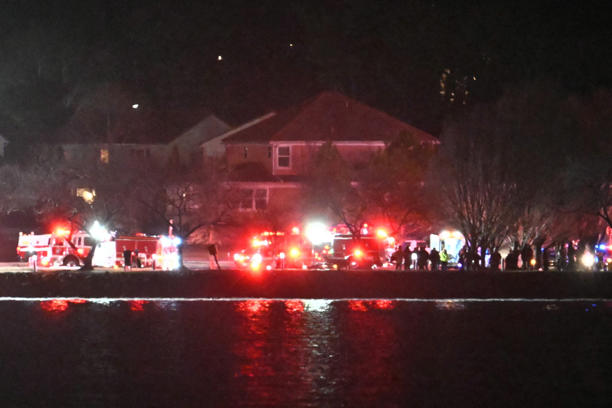
DC fire chief John Donnelly said emergency vehicles were on the scene by 8:58 p.m. to begin rescueoperations.
Human factors are just one consideration for investigators
At a briefing Thursday, officials from the National Transportation Safety Board said teams will examine human factors as they piece together a complete picture of the crash.
Related stories
Washington, DC, plane crash thrusts high-stakes role of air traffic control into the spotlight
“They will study the crew performance and all of the actions and factors that might be involved in human error, including fatigue, medication, medical histories, training, workload, equipment design, and work environment,” NTSB member Todd Inman said. They’ll also be combing through the wreckage and other evidence for clues as to what went wrong.
A preliminary FAA report obtained by the New York Times and others said staffing at National’s ATC tower was “not normal” at the time of the crash. The outlet reported that the controller was handling the duties of two people, including directing helicopters in the area and passenger planes landing and taking off.
Inman said during a Friday press conference that an air traffic controller group will be conducting interviews over the next several days for the NTSB’s investigation.
The NTSB official added that the black boxes from both aircraft, which will provide key insights into the moments leading up to the collision, were recovered.
Brian Alexander, a military helicopter pilot and a partner at aviation accident firm Kreindler & Kreindler, told BI that the nighttime conditions, many aircraft lights, and busy skies may have contributed to the catastrophe.
“There was another jet on final, a couple of other jets on final, and it’s conceivable the helicopter pilot was watching the wrong aircraft,” he said, emphasizing that was speculation at this point.
An airline pilot previously told BI that flying in and out of National was like “threading a needle” due to the highly restricted corridors and heavy traffic, including low-flying helicopters.
Sen. Tammy Duckworth, a former Black Hawk pilot, told reporters that military pilots generally wouldn’t talk directly to PSA pilots on the radio, but “everyone’s listening on the same frequency.”
She said the PSA plane would know that the Black Hawk was in the area but would be relying on ATC as the intermediary.
“Did one of the aircraft stray away latitude, sideways in the airspace from the route that they were supposed to be on? Was the Black Hawk higher than the 200 feet?” Duckworth said. “These are all things that the accident investigators would be looking at.”
The NTSB said its preliminary report is expected to be published within 30 days.
kommonsentsjane

 kommonsentsjane