
10/28/2024
Hillary will say anything to put her name on the screen to stay relevant. She has plowed her field of hate/division with the Obama’s and can’t seem to get the drift even with all of her indiscretions that whatever she is selling the American people aren’t buying it.
Billary has had her day in the sun; but, the rainbow isn’t going to show up.
We all know that Billary/Obama traded their Constitution/Bill of Rights many years ago and replaced them with Saul Alinsky’s Marxism. She lost the election to Trump – and now is still trying to make people think that Trump is the Marxist – not her and Obama.
****
Obama’s thoughts:
The solution, Obama felt, was to find a way to political power of his own.
“He was constantly thinking about his path to significance and power,” Mike Kruglik told me. “He said, ‘I need to go there [Harvard Law School] to find out more about power. How do powerful people think? What kind of networks do they have? How do they connect to each other?'”
In a few months, Obama was gone. He had been an organizer for three years. When he returned to Chicago after law school, he did some voter-registration work and then joined a civil-rights practice. In 1996, he ran for the state senate. Eight years later, he was elected to the U.S. Senate, and within a year after that he was exploring a run for president.
Hillary’s letter;
Saul Alinsky offered me the chance to work with him when I graduated from college, and he was disappointed that I decided instead to go to law school,” she wrote. “[He] said I would be wasting my time, but my decision was an expression of my belief that the system could be changed from within.”
(How interesting – THE SYSTEM COULD BE CHANGED FROM WITHIN? Isn’t that what she and Obama are trying to do with Kamala Harris’ candidacy?)
The Hillary Letters
Hillary Clinton, Saul Alinsky correspondence revealed
September 21, 2014
NOTE: READ THE HILLARY CLINTON-SAUL ALINSKY LETTERS HERE.FreeBeaconBob Menendez’s Lawyers Say Senator Hoarded Cash, Gold Because of ‘Intergenerational Trauma’Read more
Previously unpublished correspondence between Hillary Clinton and the late left-wing organizer Saul Alinsky reveals new details about her relationship with the controversial Chicago activist and shed light on her early ideological development.
Clinton met with Alinsky several times in 1968 while writing a Wellesley college thesis about his theory of community organizing.
Clinton’s relationship with Alinsky, and her support for his philosophy, continued for several years after she entered Yale law school in 1969, two letters obtained by the Washington Free Beacon show.
The letters obtained by the Free Beacon are part of the archives for the Industrial Areas Foundation, a training center for community organizers founded by Alinsky, which are housed at the University of Texas at Austin.
The letters also suggest that Alinsky, who died in 1972, had a deeper influence on Clinton’s early political views than previously known.
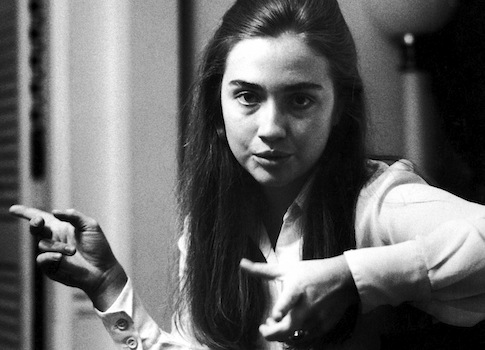
A 23-year-old Hillary Clinton was living in Berkeley, California, in the summer of 1971. She was interning at the left-wing law firm Treuhaft, Walker and Burnstein, known for its radical politics and a client roster that included Black Panthers and other militants.
On July 8, 1971, Clinton reached out to Alinsky, then 62, in a letter sent via airmail, paid for with stamps featuring Franklin Delano Roosevelt, and marked “Personal.”
“Dear Saul,” she began. “When is that new book [Rules for Radicals] coming out—or has it come and I somehow missed the fulfillment of Revelation?”
“I have just had my one-thousandth conversation about Reveille [for Radicals] and need some new material to throw at people,” she added, a reference to Alinsky’s 1946 book on his theories of community organizing.
Clinton devoted just one paragraph in her memoir Living History to Alinsky, writing that she rejected a job offer from him in 1969 in favor of going to law school. She wrote that she wanted to follow a more conventional path.
However, in the 1971 letter, Clinton assured Alinsky that she had “survived law school, slightly bruised, with my belief in and zest for organizing intact.”
“The more I’ve seen of places like Yale Law School and the people who haunt them, the more convinced I am that we have the serious business and joy of much work ahead—if the commitment to a free and open society is ever going to mean more than eloquence and frustration,” wrote Clinton.
According to the letter, Clinton and Alinsky had kept in touch since she entered Yale. The 62-year-old radical had reached out to give her advice on campus activism.
“If I never thanked you for the encouraging words of last spring in the midst of the Yale-Cambodia madness, I do so now,” wrote Clinton, who had moderated a campus election to join an anti-war student strike.
She added that she missed their regular conversations, and asked if Alinsky would be able to meet her the next time he was in California.
“I am living in Berkeley and working in Oakland for the summer and would love to see you,” Clinton wrote. “Let me know if there is any chance of our getting together.”
Clinton’s letter reached Alinsky’s office while he was on an extended trip to Southeast Asia, where he was helping train community organizers in the Philippines.
But a response letter from Alinsky’s secretary suggests that the radical organizer had a deep fondness for Clinton as well.
“Since I know [Alinsky’s] feelings about you I took the liberty of opening your letter because I didn’t want something urgent to wait for two weeks,” Alinsky’s long-time secretary, Georgia Harper, wrote to Clinton in a July 13, 1971 letter. “And I’m glad I did.”
Harper told Clinton that Alinksy’s book Rules for Radicals had been released. She enclosed several reviews of the book.
“Mr. Alinsky will be in San Francisco, staying at the Hilton Inn at the airport on Monday and Tuesday, July 26 and 27,” Harper added. “I know he would like to have you call him so that if there is a chance in his schedule maybe you can get together.”
It is unclear whether the meeting occurred.
A self-proclaimed radical, Alinsky advocated guerilla tactics and civil disobedience to correct what he saw as an institutionalized power gap in poor communities. His philosophy divided the world into “haves”—middle class and wealthy people —and “have nots”—the poor. He took an ends-justify-the-means approach to power and wealth redistribution, and developed the theoretical basis of “community organizing.”
“The Prince was written by Machiavelli for the Haves on how to hold power,” wrote Alinsky in his 1971 book. “Rules for Radicals is written for the Have-Nots on how to take it away.”
Clinton’s connection to Alinsky has been the subject of speculation for decades. It became controversial when Wellsley College, by request of the Clinton White House, sealed her 1968 thesis from the public for years. Conservative lawyer Barbara Olson said Clinton had asked for the thesis to be sealed because it showed “the extent to which she internalized and assimilated the beliefs and methods of Saul Alinsky.” Clinton opponent turned Clinton defender David Brock referred to her as “Alinsky’s daughter” in 1996’s The Seduction of Hillary Rodham.
The paper was opened to the public in 2001. While the thesis is largely sympathetic to Alinsky, it is also critical of some of his tactics.
Clinton described the organizer as “a man of exceptional charm,” but also objected to some of the conflicts he provoked as “unrealistic,” noting that his model could be difficult for others to replicate.
“Many of the Alinsky-inspired poverty warriors could not (discounting political reasons) move beyond the cathartic first step of organizing groups ‘to oppose, complain, demonstrate, and boycott’ to developing and running a program,” she wrote.
The letters obtained by the Free Beacon suggest that Clinton experimented more with radical politics during her law school years than she has publicly acknowledged.
In Living History, she describes her views during that time as far more pragmatic than leftwing.
She “agreed with some of Alinsky’s ideas,” Clinton wrote in her first memoir, but the two had a “fundamental disagreement” over his anti-establishment tactics.
She described how this disagreement led to her parting ways with Alinsky in the summer before law school in 1969.
“He offered me the chance to work with him when I graduated from college, and he was disappointed that I decided instead to go to law school,” she wrote.
“Alinsky said I would be wasting my time, but my decision was an expression of my belief that the system could be changed from within.”
ttps://independentminute.com/2024/10/27/trump-mocks-hillary-clinton-after-she-makes-wild-hitler-claim/
To read – add an ‘h’ to the above.
Trump Mocks Hillary Clinton After She Makes Wild “Hitler” Claim

Donald Trump has big plans for New York, and he’s making waves in one of the bluest states in the country. For months, the former president has been strategically targeting blue-state voters, leaving Democrats nervous as he carves out ground in traditionally left-leaning regions.
Now, Trump is taking his New York campaign to a new level, planning a massive rally in the heart of Manhattan at none other than Madison Square Garden. The event, set for October 27, promises to be an electric night for his supporters and a clear statement that he’s unafraid to bring his campaign right into the Democrats’ backyard.
But while many see this as an exciting move for Trump’s campaign, not everyone is thrilled. Hillary Clinton, a longtime Trump critic, didn’t just criticize the rally — she went so far as to compare it to a Nazi rally. Yes, you read that right. In a bizarre leap, Clinton suggested Trump’s MSG rally was akin to one of Hitler’s rallies, setting off a firestorm of backlash. Her comments were so extreme they left even some of her allies scratching their heads. Unsurprisingly, Trump didn’t take her comments lying down, firing back with his own choice words.
Fox News:
“Hillary Clinton is so messed up from her raging 8-year-long case of anti-Trump derangement syndrome that she forgot SHE did an event at Madison Square Garden when she was a senator, and her husband Bill accepted the Democrat nomination there,” Trump campaign national press secretary Karoline Leavitt said.
Trump Fires Back at Clinton’s Hypocrisy
After Clinton’s inflammatory comments, Trump’s campaign didn’t hesitate to hit back. In a statement, his national press secretary Karoline Leavitt called out Clinton’s “anti-Trump derangement syndrome,” noting that Clinton herself once held a political event at Madison Square Garden.
Not to mention, her husband, former President Bill Clinton, famously accepted the Democratic nomination at the same venue.
Leavitt’s response was sharp, pointing out the hypocrisy and questioning Clinton’s rhetoric. “Hillary’s rhetoric about half of the country is disgusting,” she said, highlighting Clinton’s track record of condescension toward Trump’s base.
Trump, ever the showman, has embraced this backlash as fuel, and he’s made it clear this rally will be a powerful demonstration of his reach and popularity in every corner of America — even in the liberal stronghold of New York City.
Madison Square Garden Set for Massive Attendance
Trump’s team is pulling out all the stops for the MSG rally, treating it as one of the high points of his campaign. Sources within the campaign say they’re expecting a packed house, with over 19,000 seats likely to be filled.
This event, following Trump’s recent large rallies across the country, shows a surge in enthusiasm from supporters who are eager to see his message delivered loud and clear.
According to a campaign official, Trump’s rallies are now drawing crowds that rival those of major music festivals. “Like Coachella and others to come, MSG is because we are adding some very big venues because we are seeing very high interest in attending events,” a campaign source told Fox News Digital.
Trump’s rally is first-come, first-serve, promising to fill the arena with fans ready to stand shoulder-to-shoulder in support. The campaign anticipates that this event will showcase the energy and diversity of his fanbase, which cuts across traditional party lines and challenges the idea that New York is a foregone conclusion for the Democrats.
Clinton’s Comments: Desperation or Derangement?
Hillary Clinton’s comments about Trump’s rally have drawn significant criticism, and not just from conservatives. Many see her reference to Nazi rallies as an attempt to stir up fear rather than engage in genuine political debate.
This isn’t the first time Clinton has made extreme remarks about Trump or his supporters, but her comments this time struck a new low, according to Trump’s campaign team.
For Trump supporters, Clinton’s words confirm what they’ve always suspected: that she and others in the Democratic establishment look down on them.
This rally, scheduled just days before the election, is the perfect opportunity for Trump to counter that narrative. As his team notes, Clinton’s comparison is hypocritical given her own ties to the very venue she’s now criticizing.
Trump’s Rally: More Than Just a Campaign Event
Trump’s Madison Square Garden rally isn’t just another campaign stop; it’s a declaration. By holding an event of this scale in the heart of New York City, Trump is challenging the long-held belief that conservative voices don’t have a place in liberal states.
He’s making it clear that he’ll campaign anywhere and everywhere, no matter how much it rattles the establishment. The rally, which takes place just nine days before Election Day, could give Trump a serious boost as he seeks to energize his base and sway undecided voters.
Trump’s decision to campaign in blue states signals a bold strategy. He’s not just aiming to win — he’s aiming to change the map and the narrative.
For Democrats, Trump’s presence in New York is a reminder that no state can be taken for granted. And for his supporters, it’s a sign that he’s more determined than ever to take his message to every corner of the country.
****
Below is a letter that Billary wrote to Saul Alinsky.
Read Hillary Clinton’s 1971 letter to Saul Alinsky
Yahoo News
Mon, September 22, 2014 at 10:55 AM CDT

A letter from Hillary Clinton to the late community organizer Saul Alinsky in 1971 was published Sunday by the Washington Free Beacon.
In it, Clinton, then a 23-year-old law school graduate living in Berkeley, Calif., informs the Chicago activist that she had “survived law school, slightly bruised, with my belief in and zest for organizing intact.”
“The more I’ve seen of places like Yale Law School and the people who haunt them,” Clinton wrote, “the more convinced I am that we have the serious business and joy of much work ahead, — if the commitment to a free and open society is ever going to mean more than eloquence and frustration.”
Clinton first met Alinsky when she was at Wellesley working on her 1969 thesis on his controversial theories on community organizing, many of which were outlined in his 1946 handbook, “Reveille for Radicals.”
In the book, Alinsky encouraged community organizers to “fan the latent hostilities” of low-income, inner city residents and “search out controversy and issues, rather than avoid them.” His 1971 book, “Rules for Radicals,” published a year before his death, expanded on that theme. “Pick the target, freeze it, personalize it, and polarize it,” Alinsky wrote.
“Dear Saul,” Clinton wrote in the 1971 letter. “When is that new book [Rules for Radicals] coming out — or has it come and I somehow missed the fulfillment of Revelation? I have just had my one-thousandth conversation about Reveille and need some new material to throw at people.”
She thanked Alinsky for the advice he gave her about campus organizing.
“If I never thanked you for the encouraging words of last spring in the midst of the Yale-Cambodia madness, I do so now,” Clinton wrote.
She also asked if they could meet the next time he was in California.
“I am living in Berkeley and working in Oakland for the summer and would love to see you,” Clinton wrote. “Let me know if there is any chance of our getting together.”
She added: “Hopefully we can have a good argument sometime in the future.”
Alinsky’s longtime secretary, Georgia Harper, sent Clinton a letter in reply informing her that he was away on a six-week trip to Southeast Asia, but that she had opened the letter anyway.
“Since I know his feelings about you I took the liberty of opening your letter because I didn’t want something urgent to wait for two weeks,” Harper wrote in the July 13, 1971, letter. “And I’m glad I did.”
“Mr. Alinsky will be in San Francisco, staying at the Hilton Inn at the airport on Monday and Tuesday, July 26 and 27,” Harper added. “I know he would like to have you call him so that if there is a chance in his schedule maybe you can get together.”
The correspondence between Alinsky and Clinton was discovered in the archives for the Industrial Areas Foundation — a training center for community organizers founded by Alinsky — housed at the University of Texas at Austin.
According to Clinton’s 2004 memoir, “Living History,” Alinsky had offered her a job after her graduation from Wellesley, but she turned him down.
“He offered me the chance to work with him when I graduated from college, and he was disappointed that I decided instead to go to law school,” she wrote. “[He] said I would be wasting my time, but my decision was an expression of my belief that the system could be changed from within.”
kommonsentsjane

 kommonsentsjane