
9/14/2023
How does this affect the oceans, etc. and Mother Nature? What are the side effects?
****
Self-made scientist invents cloud seeding
- David Tritenbach
- Aug 26, 2023
Many years ago, my father was the pastor of a church in Schenectady, New York, the city where General Electric Company had its headquarters and still does.
One afternoon when I was a youth, my father had a visitor in our manse living room, and I was introduced to him and shared some conversation with them. I hadn’t known him. Maybe he was a member of our church; I only knew he worked for General Electric. I only later learned that his name was Vincent Schaefer, the then-famous self-educated scientist who invented cloud seeding.
On July 4, 1906, American chemist and meteorologist Vincent Joseph Schaefer was born. Schaefer is best known for his research in meteorology and weather control and introduced cloud seeding. On Nov. 13, 1946, he flew over Mount Greylock in Massachusetts, successfully seeding clouds with pellets of dry ice (solid carbon dioxide) to produce the first snowstorm initiated by man.
Before World War II started, Schaefer was made research associate and continued his work with Langmuir, which included research on gas mask filtration of smokes, submarine detection with binaural sound, and the formation of artificial fogs using smoke generators — a project that reached fruition at Vrooman’s Nose in the Schoharie Valley with a demonstration for military observers. Schaefer also became internationally recognized for the development of a method to make replicas of individual snowflakes using a thin plastic coating
Around 1943, Schaefer performed many experiments at Mount Washington Observatory in New Hampshire, where he started to find his “cold box” too warm for some laboratory tests he wanted to perform. Determined to get on with his work, he located some dry ice and placed it into the bottom of the “cold box.” Creating a cloud with his breath, he observed a sudden and heretofore unseen bluish haze that suddenly turned into millions of microscopic ice crystals that dazzled him in the strobe-lit chamber. He had stumbled onto the very principle that was hidden in all previous experiments: He discovered the stimulating effect of a sudden change in heat/cold, humidity, in supercooled water spontaneously producing billions of ice nuclei.
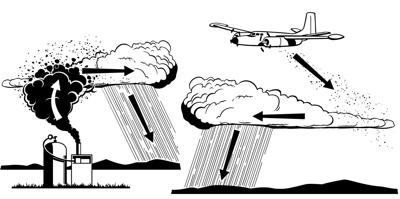
Through scores of repeated experiments, he quickly developed a method to seed supercooled clouds with dry ice, thus producing rain.
In November 1946, Schaefer conducted a successful field test, seeding a natural cloud by airplane, with dramatic ice and snow effects.
Resulting publicity brought an abundance of new correspondence, this time from people and businesses making requests for snow and water as well as scientists around the world also working on weather modification to change local weather conditions for the better.
Schaefer’s discovery also led to debates over the appropriateness of tampering with nature through cloud seeding. In addition, the successful field test enabled Dr. Irving Langmuir to obtain federal funding to support additional research in cloud seeding and weather modification by the GE Research Laboratory.
Schaefer was coordinator of the laboratory portion of Project Cirrus while the Air Force and Navy supplied the aircraft and pilots to carry out field tests and to collect data used at the research lab. Field tests were conducted in the Schenectady area as well as in Puerto Rico and New Mexico.
Schaefer died on July 25, 1993, in Schenectady, New York at age 87.
Does anyone reading this story have any information on the continuation of this science? We could still use a lot of help to get it to rain in Kerrville — and also maybe become a millionaire. Want to give it a try?
David Tritenbach is a retired Presbyterian minister.
****
kommonsentsjane

 kommonsentsjane