
ttps://www.msn.com/en-us/news/politics/liz-cheney-makes-1st-public-comment-since-trumps-election-interference-indictments/ar-AA1fsb8n
8/18/2023
MORE LIES BY Liz Cheny and her democrat ponies.
They even had to explain how the Jan6 committee was legit?
Why should anyone believe what Liz Cheney speaks? She is a traitor for starters when she ran as a Republican just to get elected when the whole time she was a Democrat and here she is trying to tell the illigitamate committee published the truth.
No, Liz – you are the “pony without a saddle.”

ABC NewsFollow
Liz Cheney makes 1st public comment since Trump’s election interference indictments.
.
ABC News
Cheney: Trump is the ‘center of the threat’ to constitutional value..
(No, you are – you faked the people of your state to become a Republican when you used them to become a Democrat.)
Former Republican Rep. Liz Cheney is speaking out on social media in the wake of the recent election interference indictments of former President Donald Trump, highlighting the work of the House Jan. 6 committee.
Despite serving as vice chair of the committee, and pledging to do whatever it takes to keep Trump out of the White House, it was Cheney’s first public comment since Trump was twice indicted on election-related charges.
In a post on X, the social media platform formerly known as Twitter, Cheney said it “might be a good time” to review the product of the panel’s 18-month investigation, pushing back on Trump’s recent claims that the House committee destroyed “all” its evidence and records.
(Maybe he used that statement to draw you “out of the dark shadows of the Democratic Party.)
“No surprise Trump doesn’t want you to see the J6 Committee evidence,” Cheney wrote as she provided a link to the government site that houses many of those records.
“Here’s the GPO website with transcripts, documents, exhibits & our meticulously sourced 800+ page final report,” Cheney wrote. “Also links to our hearings. Might be a good time to watch those again.”
MORE: Liz Cheney’s mission on Jan. 6 committee: Keep Donald Trump out of the White House
Rep. Liz Cheney (R-Wyo.) as the January 6th Committee meets for its final session at the Cannon House Office Building on Capitol Hill, Dec. 19, 2022, in Washington.© Matt McClain/The Washington Post via Getty Images
Trump has denied all wrongdoing in both criminal cases. He has pleaded not guilty to four federal charges brought by special counsel Jack Smith. Earlier this week, he was indicted in Georgia along with 18 of his allies over an alleged scheme to overturn his loss in the state.
Cheney had declared Trump “unfit for any office” as the House Jan. 6 committee wrapped up its probe, but her leading role in taking on her party’s de-facto leader cost her her political career.
(And, she is?)
In an interview with ABC News Chief Washington Correspondent Jonathan Karl last August, Cheney expressed disappointment in her Republican colleagues for their reaction to Jan. 6.
“I feel sad about where my party is,” Cheney said. “I feel sad about the way that too many of my colleagues have responded to what I think is a great moral test and challenge of our time.”MORE: ‘Huge vindication’: Jan. 6 committee members say Trump indictment in line with their findings
After Trump was charged by Smith, members of the Jan. 6 committee said the indictment lined up with their findings. Trump is facing four charges, two of which were recommended by the panel: conspiracy to defraud the U.S. and obstruction of an official proceeding.
“This does feel like a huge vindication of the rule of law and the work of the Jan. 6 committee to establish the factual narrative of what took place in the attempt to overthrow a presidential election by a president,” Rep. Jamie Raskin, D-Md., said on “GMA3.”
*****
ttps://www.govinfo.gov/collection/january-6th-committee-final-report?path=/GPO/January%206th%20Committee%20Final%20Report%20and%20Supporting%20Materials%20Collection
Select January 6th Committee Final Report and Supporting Materials Collection
*****
The facts!
Our only agenda is to publish the truth so you can be an informed participant in democracy.
We need your help.
The legitimacy of the Jan. 6 committee, explained

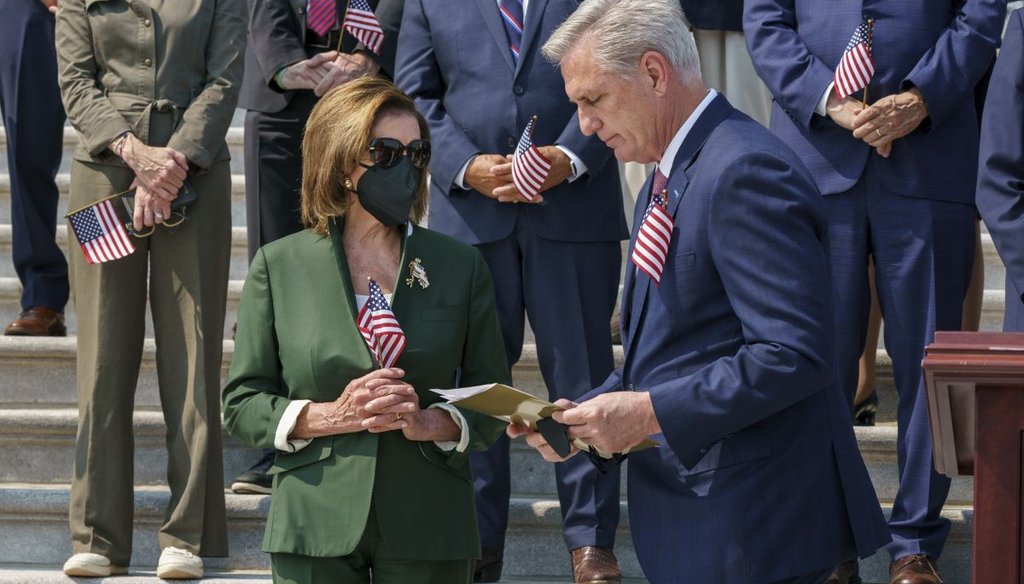
House Speaker Nancy Pelosi, D-Calif., left, stands as House Minority Leader Kevin McCarthy, R-Calif., finishes remarks during a Sept. 11 remembrance ceremony at the Capitol on Sept. 13, 2021. (AP)

By Louis JacobsonJune 8, 2022
Critics argue that the House committee investigating the events of Jan. 6, 2021, is illegitimate, amounting to a political hit job by Democrats and anti-Trump Republicans rather than a sober-minded quest to prevent disorder.
The critics also contend that the process of filling the committee’s seats was partisan, and that, as a result, the committee’s eventual composition is flawed.
Despite the criticism, the committee has withstood legal challenges against it, and experts expect the committee will complete its work.
What is the legal justification for committees of this sort?
The Constitution does not explicitly mention congressional investigations and oversight, but the courts have consistently upheld Congress’ right to undertake such activities, stemming from the text that says Congress possesses “all legislative powers.” One of the Constitution’s framers, George Mason, said during its drafting that members of Congress “are not only legislators but they possess inquisitorial powers.”
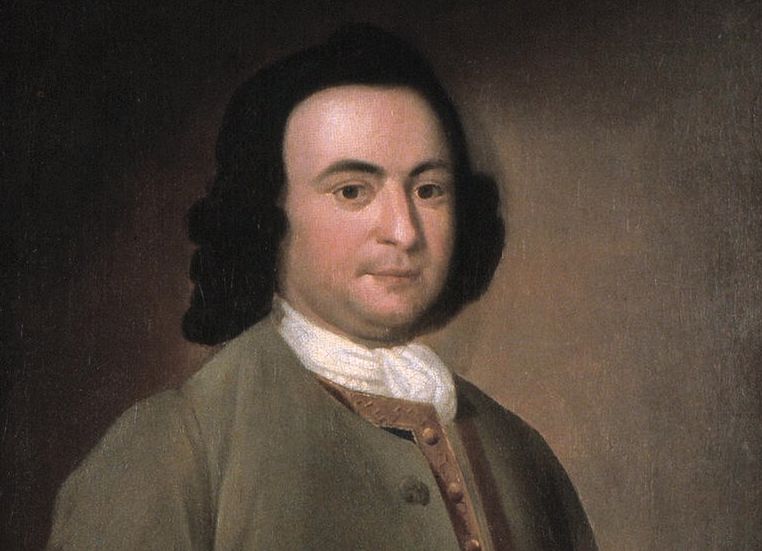
Portrait of George Mason (public domain)
With the courts’ consistent backing, Congress has undertaken investigations over the past two centuries, from the Teapot Dome corruption scandal in the 1920s to the Watergate scandal that led to President Richard Nixon’s resignation in 1974. (The House’s historical office also notes that such committees have been used for “less noble purposes, such as the blacklisting of private citizens during the ‘un-American activities’ hearings in the 1950s.”)
“How is the Jan. 6 investigation different from previous ones? My answer is, it really isn’t,” said James Robenalt, a lawyer and expert on Watergate.
How did the Jan. 6 committee come to be?
Initially, Democrats and some Republicans wanted to create an independent commission, modeled after the one that investigated the 9/11 terrorist attacks. That proposed panel would have been made up of retired public officials, military leaders, and academics, rather than sitting members of Congress. The idea was to insulate the panel’s investigation as much as possible from the partisan fray.
The bipartisan commission would have included 10 members. House and Senate leaders for the Democratic Party would appoint the commission chair and four other members, while the Republican leaders would appoint the vice chair and four other members.
The day before the House voted on the legislation, Trump came out in opposition to it and called on Republicans to “not approve the Democrat trap of the Jan. 6 Commission,” arguing that it amounted to “more partisan unfairness.” House Republican leaders joined Trump in opposition. Despite this, the House passed the legislation, with universal support from Democrats and the backing of 35 breakaway Republicans.
But the Senate killed the commission idea after Minority Leader Mitch McConnell, R-Ky., came out against it, effectively ending any hope that the bill could get the 60 votes needed to overcome a filibuster.
Democratic leaders’ Plan B was to establish a congressional select committee — a time-limited panel with a specific investigative charge. This could be accomplished by the House on its own; a simple majority in the House would carry the day.
“Our bipartisan, good-faith proposal was met with a filibuster,” House Homeland Security Chairman Bennie Thompson, D-Miss., said at the time. “Now that Senate Republicans have chosen to block the formation of an independent commission, it falls to the House to stay the course and get the answers they deserve.”
On June 30, 2021, the House approved creation of the select committee to Investigate the Jan. 6 Attack on the United States Capitol. The resolution passed by a 222-190 margin. Once again, Democrats were unified in support, but the number of Republican votes in favor withered to two: Reps. Liz Cheney of Wyoming and Adam Kinzinger of Illinois.
Under the resolution, “the Speaker shall appoint 13 Members to the Select Committee, 5 of whom shall be appointed after consultation with the minority leader.”
This is where matters got even more convoluted. House Minority Leader Kevin McCarthy, R-Calif., presented Speaker Nancy Pelosi, D-Calif., with a slate of five nominees to the panel. Pelosi responded that she had no quarrel with three of them: Republican Reps. Rodney Davis of Illinois, Kelly Armstrong of North Dakota, and Troy Nehls of Texas. But she drew the line at two of McCarthy’s picks: Indiana Rep. Jim Banks, who was tapped for the panel’s ranking member slot, and Ohio Rep. Jim Jordan. Pelosi maintained that Banks and Jordan were too closely tied to Trump to help carry out a credible investigation.
After Pelosi rejected Banks and Jordan, McCarthy retracted all five of his nominations, including the three that Pelosi had said she’d accept. “Speaker Nancy Pelosi has taken the unprecedented step of denying the minority party’s picks for the Select Committee on January 6,” McCarthy said at the time. “This represents an egregious abuse of power and will irreparably damage this institution.”
But Pelosi had one last move. She proceeded to name the two Republicans who had voted to establish the committee — Cheney and Kinzinger — as members, joining seven Democrats. This produced a committee that was bipartisan, but excluded lawmakers who Democrats believed could be tempted to use the panel as a platform to justify the actions of Trump and his allies, rather than investigate them.
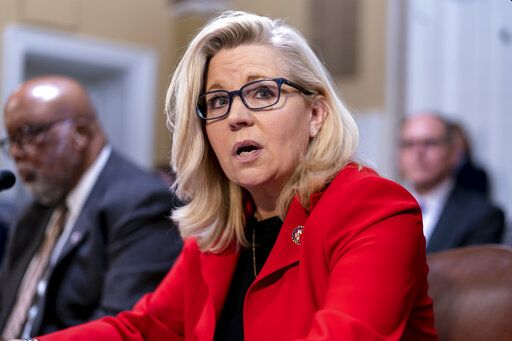
Jan. 6 Committee Vice Chair Liz Cheney, R-Wyo., and Chairman Bennie Thompson, D-Miss., at the Capitol on April 4, 2022. (AP)
Why do critics say the panel is illegitimate?
In a lawsuit, the Republican National Committee argued that there were several problems with the select committee’s formation.
First, rather than 13 members, as set out in the resolution, the panel ended up with only nine. Second, the panel has no “ranking member,” as had been called for in the resolution. And third, the Republicans on the committee were not ones recommended by the Republican leader, McCarthy.
On May 1, the U.S. District Court for the District of Columbia ruled that none of these concerns were enough to stop the committee’s work. The ruling was made by Timothy J. Kelly, a Trump appointee.
Kelly wrote that concern over the numerical divergence was “not an unreasonable position,’” but he added that the court “must give ‘great weight’ to the House’s own actions,” including two occasions when House Republicans failed to challenge the committee’s underlying legitimacy before casting votes related to the committee.
The House has also argued that there’s precedent for a committee with incomplete membership: a 2005 House panel to investigate the government response to Hurricane Katrina consisted of 11 Republicans and zero Democrats. (Ironically, at the time, Pelosi, then the House minority leader, called the panel a “sham” and refused to name committee members.)
As for the question of a ranking member, Kelly concluded that Cheney, as the panel’s vice chair, fulfilled the same function as a ranking member even if her title was different. And on the question of McCarthy’s lack of input, Kelly pointed to the resolution’s requirement that the speaker needed only to engage in “consultation” with the minority leader.
“To ‘consult’ with Minority Leader McCarthy, all Speaker Pelosi had to do was ask for his ‘advice or opinion,’” Kelly wrote. “There is no dispute that she did. That she did not accept all his recommendations, and that Minority Leader McCarthy then withdrew all his recommendations, does not mean that Speaker Pelosi failed to consult with him.”
Another broad complaint in the lawsuit is that the committee’s actions are not advancing a valid legislative purpose.
This argument didn’t fly with Kelly, either, who noted the committee’s purpose was to investigate if legislation is necessary “to avert a future Jan. 6-style attack.” He reasoned that the committee need not commit to specific legislation in advance of starting its work, since possible legislation could easily emerge once the committee’s efforts were underway.
Kelly’s decision was in line with an earlier decision by the U.S. Court of Appeals for the D.C. Circuit. In December 2021, a three-judge panel ruled against Trump’s attempts to block the National Archives from turning over presidential correspondence and documents to the Jan. 6 committee.
The appeals judges wrote that there are “few, if any, more imperative interests squarely within Congress’s wheelhouse than ensuring the safe and uninterrupted conduct of its constitutionally assigned business.”
Further bolstering the House panel’s case is that a month later, the Supreme Court denied a motion by Trump to overturn the appeals court decision.
The collective result of these court decisions, Robenalt said, is to show that “the committee was properly authorized and that Congress has the power to investigate for valid legislative purposes.”
Sign Up For Our Weekly Newsletter
Our Sources
House Historical Office, “Investigations & Oversight,” accessed June 8, 2022
Congress.gov, “H.R. 3233 – National Commission to Investigate the January 6 Attack on the United States Capitol Complex Act“
Roll call vote on H.R. 3233
Congress.gov, “H.Res.503 – Establishing the Select Committee to Investigate the January 6th Attack on the United States Capitol“
Roll call vote on H.Res. 503
Reuters, “U.S. House Speaker Pelosi names Republican Kinzinger to Jan. 6 panel,” July 25, 2021
U.S. District Court for the District of Columbia, ruling, May 1, 2022
U.S. Court of Appeals for the D.C. Circuit, ruling, Dec. 9, 2021
Supreme Court, denial of stay, Jan. 19, 2022
Nancy Pelosi, “Pelosi Statement on Partisan Select Committee on Katrina Response,” Sept. 21, 2005
Lawfare, “Trump Loses Big on Executive Privilege,” Jan. 20, 2022
Politico, “Jan. 6 committee rebuts challenges to its legitimacy, citing Katrina and Benghazi probes,” Jan. 13, 2022
Roll Call, “House votes to hold Mark Meadows in contempt of Congress,” Dec. 14, 2021
NPR, “The House votes to hold Steve Bannon in contempt for defying a subpoena,” Oct. 21, 2021
CBS, “McCarthy pulls all Republicans from January 6 Select Committee after Pelosi rejects two picks,” July 21, 2021
CNN, “House votes to create select committee to investigate January 6 insurrection,” June 30, 2021
PolitiFact, “What is the scope of the proposed Jan. 6 commission? And is there a Plan B?” May 21, 2021
PolitiFact, “Is a select congressional committee the next best option for probing Jan. 6?” June 14, 2021
PolitiFact, “House hearings about the Jan. 6 insurrection begin this week. Here’s what to watch,” June 7, 2022
Email interview with Steven Smith, political scientist at Washington University in St. Louis, June 7, 2022
Email interview with Donald Wolfensberger, congressional scholar at the Woodrow Wilson International Center for Scholars, June 7, 2022
Email interview with James Robenalt, attorney with Thompson Hine LLP, June 7, 2022
About Select January 6th Committee Final Report and Supporting Materials Collection
The House Select Committee to Investigate the January 6th Attack on the United States Capitol released their final report on December 22, 2022. This page provides access to the report as well as additional supporting materials provided by the committee, including videos, transcripts, and other documents on file. Visit the committee’s website for more information.
Browse Select January 6th Committee Final Report and Supporting Materials Collection
January 6th Committee Final Report and Supporting Materials Collection
Final Report
Supporting Materials – Court Documents
Supporting Materials – Documents on File with the Select Committee
Supporting Materials – Select Committee Hearing Videos
Supporting Materials – Transcribed Interviews and Depositions
Supporting Materials – Video Exhibits
Supporting Materials – Web Resources Referenced by the Committee
*****
God Bless America.
kommonsentsjane

 kommonsentsjane