
7 Things You Need To Know About Pearl Harbor
By: Aaron Bandler,
December 8, 2016
Wednesday marked the 75th anniversary of Pearl Harbor. Across the country, flags were lowered to half-mast, memorials were held and politicians spoke to honor those who perished that day.
Here are seven things you need to know about Pearl Harbor.
1. The attack caught the United States by surprise. Tensions had risen between Japan and the U.S. when the U.S. imposed sanctions and trade embargoes on Japan as punishment for declaring war on China. The U.S. had thought that Japan wouldn’t be the first country to launch an attack against the U.S., and if they did it would be on a South Pacific European colony. However, that expectation left Pearl Harbor “relatively undefended.”
“Almost the entire Pacific Fleet was moored around Ford Island in the harbor, and hundreds of airplanes were squeezed onto adjacent airfields,” states History.com. “To the Japanese, Pearl Harbor was an irresistible target.”
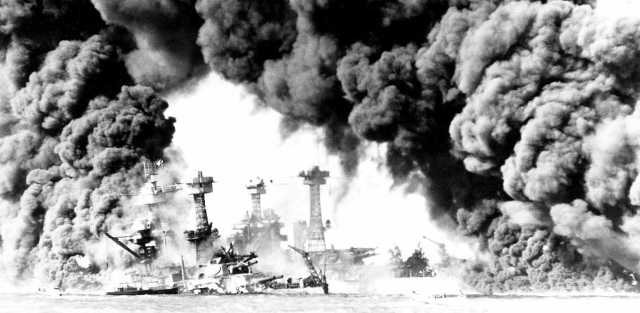
2. The attack resulted in mass casualties and destruction of military equipment. Per History.com:
At about 8 a.m., Japanese planes filled the sky over Pearl Harbor. Bombs and bullets rained onto the vessels moored below. At 8:10, a 1,800-pound bomb smashed through the deck of the battleship USS Arizona and landed in her forward ammunition magazine. The ship exploded and sank with more than 1,000 men trapped inside. Next, torpedoes pierced the shell of the battleship USS Oklahoma. With 400 sailors aboard, the Oklahoma lost her balance, rolled onto her side and slipped underwater. By the time the attack was over, every battleship in Pearl Harbor–USS Arizona, USS Oklahoma, USS California, USS West Virginia, USS Utah, USS Maryland, USS Pennsylvania, USS Tennessee and USS Nevada–had sustained significant damage. (All but USS Arizona and USS Utah were eventually salvaged and repaired.)
In all, the Japanese attack on Pearl Harbor crippled or destroyed nearly 20 American ships and more than 300 airplanes. Dry docks and airfields were likewise destroyed. Most important, almost 2,500 men were killed and another 1,000 were wounded.
The U.S.S. Arizona still resides underneath the water, with 1,177 military personnel still inside of it.
3. Pearl Harbor immediately changed the mood of the country toward World War II. Before Pearl Harbor, at least 40 percent of Americans were against involvement in the war since they had just fought in World War I, which at the time was considered to be the “war to end all wars.” The country was clearly split on whether to enter the war. After Pearl Harbor, Americans did an about-face.
“You had more enlistments on December 8 than any other day in American history,” Ambrose told National Geographic Today.
President Franklin Delano Roosevelt gave a stirring speech rallying Congress and the American people to go to war, invoking the now famous “date which will live in infamy” line. Congress approved his declaration of war. Japan had attacked Pearl Harbor hoping that the U.S. would end the economic sanctions and trade embargoes against them, but instead felt the full wrath of America.
4. Roosevelt almost didn’t use the word “infamy” in his speech. The line originally read: “Yesterday, December 7, 1941, a date which will live in world history, the United States of America was simultaneously and deliberately attacked by naval and air forces of the Empire of Japan.”
Roosevelt later made various edits to the speech, such as inserting the word “infamy.”
“It gives greater meaning,” White House speechwriter Sarada Peri said in a Washington Post podcast. “He is making a judgment call about what this moment is. It is an act that is treacherous and requires some kind of response, and it’s part of what speech writing is about, which is clarifying to the point of finding the right word.”
Roosevelt’s full speech can be seen below:
5. Hawaii was put into martial law after Pearl Harbor for three years. The military forced a curfew onto Hawaiians at night, forcing everyone to be indoors with their electricity completely off, and anyone who was outside after hours would face arrest or possibly even shot.
Residents were also forced to build bomb shelters and barbed wire fences and have an identification card. Alcohol of any kind was banned–as was taking any photographs–and food was rationed. The military also confiscated the tourist-laden hotels on the beaches of Waikiki.
Hawaii was a territory at the time, so the military’s treatment of Hawaiians after Pearl Harbor helped set forth the initiative for Hawaii to become a state.
6. Shinzo Abe, Japan’s prime minister, will be the first Japanese leader to visit Pearl Harbor. Abe will be visiting after Christmas, where he is not expected to give an apology for the attack but will offer reconciliation.
Some Japanese pilots that were involved in the attack have visited Pearl Harbor and have also offered reconciliation instead of an apology.
7. The Pearl Harbor survivors have forgiven the Japanese for the attack. Daniel Martinez, the main historian on Pearl Harbor, told National Geographic that “there was a lot of anger, hurt, and hatred” when the World War II Valor in the Pacific National Monument opened in 1962, but the process of reconciliation occurred when President George H.W. Bush declared in 1991 that he had “no rancor in my heart toward Germany or Japan—none at all.”
“He nullified a lot of anger and gave us the ability to use his words as a policy,” Martinez said. “It became the way that we conducted ourselves from that time forward.”
Martinez said that the “museum has become a place of healing,” as evident by a Japanese tea ceremony being held at the memorial.
kommonsentsjane

 kommonsentsjane