
One thing about life, you never know what something is worth. So be careful before you destroy anything. Remember one person’s junk is another person’s treasure. Even Congress got in on the act. Congress actually approved research on the taxpayers’ dime of $3.2 million to find out how Jesus’ picture appeared on a piece of toast . This tells you how these people’s minds work; and, these are the very same people who manage our money.
Image of piece of toast with Jesus’ picture on it which Congress studied:
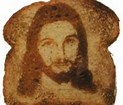
Before you chomp down on any of your food be sure and check it out because you never know whose picture might be on it. Now for another story about toast.
‘Virgin Mary’ toast fetches $28,000.
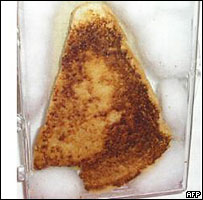
A piece of cheese on toast purportedly showing the Virgin Mary. The toast is not intended for consumption
A decade-old toasted cheese sandwich said to bear an image of the Virgin Mary has sold on the eBay auction website for $28,000.
An internet casino confirmed it had purchased the sandwich, saying it had become a “part of pop culture”.
Goldenpalace.com says it will take the sandwich on world tour before selling it and donating the money to charity.
Diane Duyser, from Florida, says the sandwich has never gone mouldy since she made it 10 years ago.
By the time the sandwich auction closed on Monday the sale had received over 1.7 million hits on the auction site.
‘Mystical power’
“We will definitely use the sandwich to raise money for charity, and we hope it will raise people’s spirits as well,” said Richard Rowe, the casino’s CEO.
“With the… thousands of search engine queries, it is obvious that this is something people want to know more about… and Golden Palace will help spread the word.
“We believe that everyone should be able to see it and learn of its mystical power for themselves.”
Last week, Mrs Duyser told reporters the sandwich had brought her luck – including winnings of $70,000 at a casino near her Florida home.
A piece of cheese on toast purportedly showing the Virgin Mary
Mrs Duyser says she noticed the image burned into her sandwich as she was about to tuck into it in autumn 1994.
“I went to take a bite out of it, and then I saw this lady looking back at me,” she said, according to the Chicago Tribune newspaper.
“I hollered for him,” she said, gesturing to her husband, Greg. “It scared me at first.”
She says she has done nothing to preserve the sandwich except keeping it in a plastic box, but “it doesn’t fall apart or crumble or anything”.
Nevertheless, before auctioning her sandwich Mrs Duyser cautioned buyers that it was “not intended for consumption”.
The item has inspired sellers to place dozens of spin-off items on the online auction site, including attempts at replica burnt toast, T-shirts, ornamental plates, and domain names.
One seller is even offering a “Virgin Mary” sandwich toaster – though the item description includes the caveat that the item “may or may not reproduce the Virgin Mary image”.
***************************
Humans spend so much time looking at each other that it’s perhaps no surprise we see faces where they’re not — on trees, clouds, the surface of Mars and, of course, toast. But some people tend to see faces more than others and a strong belief in religion or the supernatural may be the culprit, a new small study suggests.
Researchers from the University of Helsinki in Finland studied how 47 adults saw faces in dozens of pictures of lifeless objects and landscapes, such as a rock wall or tools arranged on a table. Some pictures had distinct facelike characteristics, with eyes and a mouth at the minimum, while others had no clear facelike features.
After the experiments, the participants filled out a questionnaire to measure their religiosity as well as their belief in the paranormal. For example, the subjects were asked whether they believed in God, thought people could move objects with their mind or believed individuals could use astrology to accurately predict the future.
The religious people and those who believed in paranormal phenomena saw faces more often than the non-religious and the skeptics, the researchers found. The believers also were more prone to false alarms, picking out faces in an image that lacked clear facelike features. In one part of the test, the subjects had rated the face-likeness and emotional expression of the faces they saw. The set of supernatural believers was more likely than the skeptics to rate the illusory features as very facelike and emotional. (The same pattern was observed in the religious vs. non-religious groups, but the difference was not significant, the researchers said.)
Scientists who study religion have suggested that anthropomorphism — the assignment of uniquely human properties to nonhuman phenomena — helps explain a tendency to believe in gods. The results of the new study seem to strengthen these ties, as illusory face detection, sometimes known as pareidolia, could be loosely considered a form of anthropomorphism. The results also might explain why every so often, a piece of toast, pancake or potato chip with the face of Jesus turns up on the news or for sale on eBay.
And perhaps they are also behind our otherworldly anthropomorphism, including the many faces seen on Mars — a 2011 spotting came from Google Mars maps, with a man claiming to see a profile of Mahatma Gandhi gracing the Red Planet’s surface.
The study was detailed online last month in the journal Applied Cognitive Psychology.
kommonsentsjane

 kommonsentsjane