
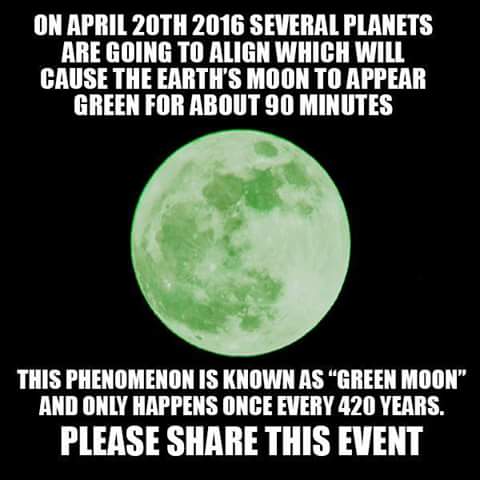
On April 20, 2016, several planets are going to align which will cause the earth’s moon to appear green for about 90 minutes. I hope this is true.
In modern use, when 13 full moons occur in a year, usually one calendar month has two full moons; the second one is called a “blue moon”. On rare occasions in a calendar year (as happened in 2010 in time zones east of UTC+07), both January and March each have two full moons, so that the second one in each month is called a “blue moon”; in this case, the month of February, with only 28 or 29 days, has no full moon.
Harvest Moon Colors
At times the moon might look red, orange or even blue. The moon appears to be certain colors during certain times of the year. For instance, the Harvest moon during the fall appears very large and orange. There are two reasons for this, the moon’s path across the sky, and the climate of earth. During certain times of the year, the moon will rise and set at different angles. Sometimes the moon stays really low in the sky and never reaches an overhead position. The earth’s atmosphere also goes through certain changes at certain times of the year.
In some months, the atmosphere has more dust particles than usual; in other months, the atmosphere contains a lot more cloud particles than usual. Extra particles in the atmosphere mean more scattering of light. In the fall, many farmers are harvesting their crops. Lots of dust from the soil of the crops gets disturbed. The dust floats into the atmosphere. At the same time, the moon is lower in the sky during the fall season. So if there’s more dust in the sky and the moon is closer to the horizon, then what color will the moon be? Orange! That’s where “Harvest Moon” gets its name.
“The Orange Moon”
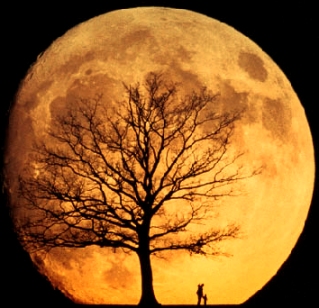
Have you ever wondered why the moon is more orange or yellow in color when it first rises at night. This effect is caused by the atmosphere of the earth. The reason for the orange color is due to the scattering of light by the atmosphere. When the moon is near the horizon, the moonlight must pass through much more atmosphere than when the moon is directly overhead. By the time the moonlight reaches your eyes, the blue, green, and purple pieces of visible light have been scattered away by air molecules. That’s why you only see yellow, orange, or red.
The moon can have an orange color at any time of the year. Sometimes the moon appears orange even when it’s directly overhead. This occurs when there’s a lot of dust, smoke, or pollution in the atmosphere. The size of those particles will determine the type of color you will see.
Viewing Cause And Effect
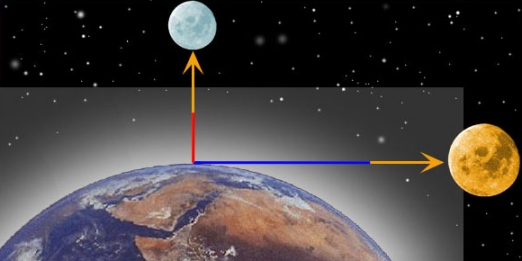
Look first at the white moon directly overhead. See the red part of the arrow pointing to the white moon? This red part of the arrow shows the part of the atmosphere we are looking through to see the moon. Now look at the orange moon just rising in the east. Look at the blue portion of the arrow pointing to the orange moon. See how much longer the blue line is than the red line. This shows that we are looking through about three times as much atmosphere at a rising or setting moon.
kommonsentsjane

 kommonsentsjane