

Watching all of the regalia on the beaches for Spring break sparked a thought from prior years when young girls talked about virginity. If one could take a count from that scene, wonder if they all are virgins? Years ago, many young girls would make a statement such as, “I am saving myself for my husband.” Watching the news told a different story when one of the statements was, “Why I have had ten men today!” So, in today’s world there is a different perspective. Wonder if young girls and boys on a date brag about such statements? I guess it just doesn’t matter any more.
What does virginity mean to young people today? I can just see and hear all of you snickering at this very moment. The old story is:
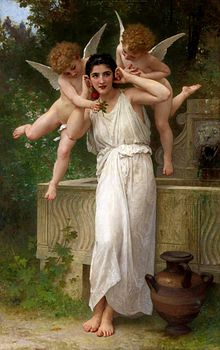
Youth by French painter William-Adolphe Bouguereau. White has traditionally been associated with ritual purity, innocence and virginity.
Virginity is the state of a person who has never engaged in sexual intercourse. There are cultural and religious traditions which place special value and significance on this state, especially in the case of unmarried females, associated with notions of personal purity, honor and worth.
Like chastity, the concept of virginity has traditionally involved sexual abstinence before marriage, and then to engage in sexual acts only with the marriage partner. The concept of virginity usually involves moral or religious issues and can have consequences in terms of social status and in interpersonal relationships. Although virginity has social implications and had significant legal implications in some societies in the past, it has no legal consequences in most societies today.
The term virgin originally only referred to sexually inexperienced women, but has evolved to encompass a range of definitions, as found in traditional, modern, and ethical concepts. Heterosexual individuals may or may not consider loss of virginity to occur only through penile-vaginal penetration, while people of other sexual orientations often include oral sex, anal sex or mutual masturbation in their definitions of losing one’s virginity.
The word virgin comes via Old French virgine from the root form of Latin virgo, genitive virgin-is, meaning literally “maiden” or “virgin”—a sexually intact young woman or “sexually inexperienced woman”. As in Latin, the English word is also often used with wider reference, by relaxing the age, gender or sexual criteria. Hence, more mature women can be virgins (The Virgin Queen), men can be virgins, and potential initiates into many fields can be colloquially termed virgins; for example, a skydiving “virgin”. In the latter usage, virgin means uninitiated.
The Latin word likely arose by analogy with a suit of lexemes based on vireo, meaning “to be green, fresh or flourishing”, mostly with botanic reference—in particular, virga meaning “strip of wood”.
The first known use of virgin in English is found in a Middle English manuscript held at Trinity College, Cambridge of about 1200:
Ðar haueð … martirs, and confessors, and uirgines maked faier bode inne to women. — Trinity College Homilies
Traditionally, there was a cultural expectation that a female would not engage in premarital sex and would come to her wedding a virgin, which would be indicated by the bride wearing a white gown, and that she would “give up” her virginity to her new husband in the act of consummation of the marriage.
It was the law and custom in some societies that required a man who seduced or raped a virgin to marry the girl or pay compensation to her father. In some countries, until the late 20th century, a woman could sue a man who had taken her virginity but did not marry her. In some languages, the compensation for these damages are called “wreath money”.
Some cultures require proof of a bride’s virginity before her marriage.
According to a 2001 UNICEF survey, in 10 out of 12 developed nations with available data, more than two thirds of young people have had sexual intercourse while still in their teens.
kommonsentsjane

 kommonsentsjane