
09/12/2025
Welcome to Our World:
Trump’s economy hasn’t blown up under tariffs as many predicted. Is he really proving the naysayers wrong?

We have the duly-elected President putting our country first after it was pilfered by the previous administration and he is working 24/7 to put us back in contention with the rest of the world and the left is kicking and screaming about the progress. All of the left’s Democrats’ final reports were fraud for starters.
The left is still sitting on the sidelines moaning and groaning that they didn’t like DOGE since it’s streaming puts a “clean” or “dirty” face on the results.
The rest of the world loved what the Biden administration did to us and now are bitching about the tariffs which are placed to put us on equal footing. Did they offer to help us?
They lost their bread basket of the world and that is what they don’t like – the foreign aid.
The President never said it “was going to be easy.” In fact, he stated that it would be rough until we can get our feet on the ground and start up the American manufacturing engine. After the last 12 years of licking our Democrat wounds, a dragging sick ruler, and listening to the fake news was not easy. We sure miss the “O’Reilly” reports that we could depend on to be true. In fact we don’t even watch TV any more.
It is time for the left to rise to the occasion and get a job to help our job numbers.
htps://www.msn.com/en-us/money/markets/trump-upends-the-international-economic-order/ar-AA1Mrfri?ocid=msedgdhp&pc=U531&cvid=68c4776a75114899bc1357ed49109cf5&ei=43
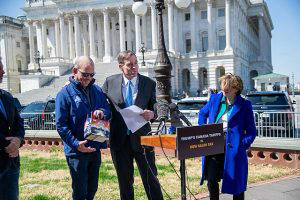
Image by Senator Mark Warner, Creative Commons 2.0.
Trump Upends the International Economic Order
Protectionism by Another Name
Tariff hikes across the board, political interference through trade threats, pressure on US multinational corporations, supply chain disruptions—these are among the ways the Trump administration is trying to change economic globalization, from one based on consensus among the major trading states to one based on America First. Few countries find America First a model worth supporting.
Trump administration officials consider the global trading order established at the end of World War II “untenable and unsustainable,” to quote Jamieson Greer, the US trade representative. He writes about “American frustration at the system’s failure to adapt to meet the essential needs of sovereign nations,” which really means the US alone.
The alternative? Not a new global system based on multilateral cooperation, since that would limit US actions. Instead, the Trump people prefer “a mix of tariffs and deals for foreign market access and investment”—in other words, the approach taken with the European Union (EU) and Japan.
And as between tariffs and “deals,” tariffs have priority because they can punish countries that have protected their markets and used various measures, such as subsidies and “lax labor and environmental standards,” to enhance their trade position. China comes first to mind. The administration is determined to stop the consequent flight of US capital and production abroad.
I will let Donald speak for himself.
****

‘Taxes Unless They Behave’: When Donald Trump Unveiled His Disastrous Tariff Policy In The 2016 Republican Primary Debates
This America First argument is a recipe for trade protectionism, the weaponization of tariffs, and shakedown of US corporations. We can see the early results: not a win for American workers and consumers, nor even for many multinational corporations, but another opportunity for the concentration of political power in the Oval Office.
Tariffs can be wielded to benefit those who are willing to play Trump’s game: invest in the US or suffer the consequences. In an unprecedented display of state capitalism, the administration has taken a slice of investment deals abroad—such as Nvidia’s AI chip sales in China—and a government share in US corporations, as in the Nippon Steel-US Steel deal and the 10% government share Trump demanded of Intel.
Trump’s New Trading Order
Trump’s new trading order doesn’t distinguish between friend and adversary. Tariffs are being imposed based mainly on political rather than commercial considerations. With few exceptions—Russia, so far, is one—high tariffs have hit India, Canada, Japan, South Korea, and the European Union just as hard as they have hit China.
The US trade deficit is rarely cited as the main reason for the high tariffs. India’s purchases of Russian oil, Canada’s constant criticism of Trump, South Korea’s low level of military spending, Brazil’s trial of right-wing former president Jair Bolsonaro, and China’s challenge to the US as global leader—these are among the actual reasons for Trump’s tariffs. He’s a spiteful and vengeful man.
Careful reflection on the possible reactions of countries hit with the tariffs doesn’t seem to have occurred in the Trump camp. Trump and his inner circle have always been oblivious to the power of nationalism abroad even as they nurture American nationalism.
The Canadians have turned to other markets and to “buy Canadian.” No Kentucky bourbon on their shelves!
India is boycotting US goods, and its leader is cozying up to Beijing and Moscow.
The Chinese have embraced self-reliance in computer chips, to the point where car manufacturers are being told to stop using foreign chips. A boycott of US soybeans, sales of which Trump had insisted China should double, is underway.
Brazil’s leader has firmly rejected Trump’s interference in its judicial processes.
South Korea, Japan, and the EU have all pledged major new investments in the US, knowing full well that they can string along the actual investment process—and might never have to make them at all if there’s a change in administration.
Writing in Foreign Affairs, Michael Froman warns:
“If Washington continues on its current course—defined by unilateralism, transactionalism, and mercantilism—the consequences will be grim, especially as Beijing continues on its own damaging course of subsidized excess capacity, predatory export policies, and economic coercion. The risk of the United States and China playing by their own rules, with power the only real constraint, is contagion: if the two largest economies in the world operate outside the rules-based system, other countries will increasingly do the same, leading to rising uncertainty, drags on productivity, and lower overall growth.”
In the Real World, Bad News for Trump
Blame should, however, fall mainly on the US, for while Trump is rejecting globalization, the Chinese are embracing it. If the entry of their goods into US markets is proving too expensive, they are moving exports and production elsewhere.
The Chinese have become Global South leaders through their Belt and Road Initiative, which provides development loans, and through the export of goods, services, and production lines, particularly to Africa and Southeast Asia but increasingly to Latin America. The more trade pressure Trump exerts, the better the Chinese look to many developing countries.
The US economy is supposed to be the chief beneficiary of these trade policy shifts. But it’s not happening. At a macroeconomic level, there is modest growth in GDP. And corporate profits are up. But most key indicators of economic health speak to serious problems already in sight or soon to be. Job figures are far below expectations.
Fortune magazine reports that a third of American CEOs plan to reduce their work force and increase prices. Farmers who rely on migrant labor are suffering. Consumer confidence and spending are down, inflation is moving upwards, home purchases are down, and foreign tourism is way down. Some economists are predicting a recession, others stagflation.
Trump’s tariffs are widely understood to be a national sales tax which, as Forbes reports, “will yank back from consumers’ wallets about half the projected tax savings from the One Big Beautiful Bill’s extension of the 2017 Trump tax cuts.”
Yet Trump and his yes-men will continue to claim to the bitter end that all the bad news is fake and that tariffs are working as intended. But have you noticed that they now say the good news won’t come until next year?
****
(The above paragraph is a good example. He is not blaming Biden/Obama for the 12 years of weaponization/corruption and fraud committed. Still blaming the President. Stupid is as stupid does.)
Mel Gurtov, syndicated by PeaceVoice, is Professor Emeritus of Political Science at Portland State University.
Source: Originally published by Z. Feel free to share widely.
kommonsentsjane

 kommonsentsjane